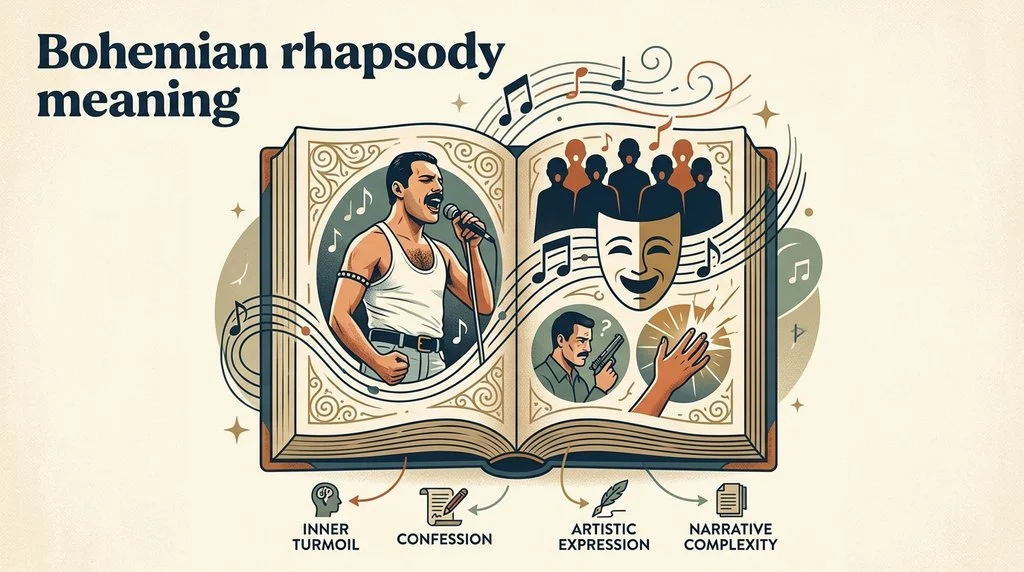
If you’ve ever searched for the bohemian rhapsody meaning, you’re not alone. Queen’s “Bohemian Rhapsody” is one of the most famous and mysterious songs in music history. Its dramatic shifts, unusual lyrics, operatic section, and emotional ending have inspired countless interpretations.
But does the song have one definite meaning? Not necessarily. Freddie Mercury wrote the song, yet he famously kept much of its meaning private. That leaves listeners with plenty of clues, theories, and room for personal interpretation.
What Does “Bohemian Rhapsody” Mean?
The bohemian rhapsody meaning is not a simple definition because the song combines several emotional and musical ideas into one unconventional story.
At its most basic level, “Bohemian Rhapsody” can be understood as a dramatic piece about guilt, fear, confession, consequence, emotional conflict, and acceptance.
However, there is no officially confirmed explanation that reveals exactly what every lyric represents.
Freddie Mercury deliberately left the song open to interpretation. He did not provide a detailed explanation of the lyrics, which allowed listeners to develop their own understanding.
The song was released by Queen in 1975 on the album A Night at the Opera. Rather than following the traditional structure of a pop song, it moves through several distinct musical moods:
- A quiet, reflective opening
- A dramatic ballad section
- A powerful guitar passage
- An elaborate operatic section
- A hard-rock climax
- A calm, emotional ending
This unusual structure is a major reason the song feels more like a miniature musical drama than an ordinary pop single.
What Does the Title “Bohemian Rhapsody” Mean?
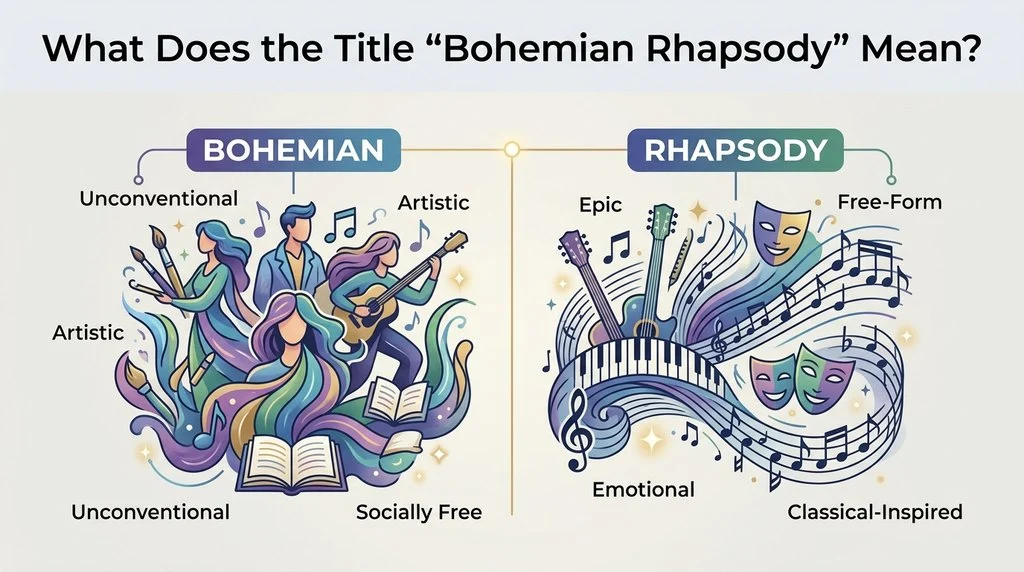
The title itself provides some clues.
What Does “Bohemian” Mean?
The word Bohemian can have several meanings.
Historically, it can refer to someone from Bohemia, a region associated with the Czech lands. But in modern cultural language, “bohemian” can describe someone associated with an unconventional, artistic, or nontraditional lifestyle.
The word can therefore suggest ideas such as:
- Artistic freedom
- Individuality
- Nonconformity
- Creativity
- An unconventional way of living
What Does “Rhapsody” Mean?
A rhapsody is a musical composition that generally has a free-flowing or expressive structure.
Unlike a straightforward song with one repeated pattern, a rhapsody can move between different moods and musical ideas.
That description fits “Bohemian Rhapsody” remarkably well.
The song moves from intimate singing to opera-like vocals and then into hard rock before ending quietly. In that sense, the title reflects both the song’s artistic character and its unusual musical form.
The Main Meaning Behind “Bohemian Rhapsody”
There isn’t one universally accepted interpretation of the song.
Instead, several ideas have become closely associated with it.
1. Guilt and Confession
The opening section presents a speaker who appears to be dealing with the consequences of a serious act.
The lyrics immediately create a feeling of uncertainty and emotional distress.
The speaker seems to be asking whether what happened was real, imagined, or somehow unavoidable.
This gives the beginning a confessional quality.
2. Fear of Consequences
As the song develops, the emotional pressure increases.
The narrator appears frightened by what may happen next. References to death, punishment, and pleading create the impression of someone facing consequences.
The song therefore works as an emotional journey from confusion to fear.
3. Identity and Inner Conflict
Another common interpretation focuses on personal identity.
The narrator appears divided between different emotional states. The song’s sudden changes in musical style reinforce this feeling.
One moment is gentle and vulnerable.
The next is theatrical.
Then it becomes aggressive and rebellious.
These changes can be interpreted as representing an internal struggle.
4. Acceptance and Letting Go
Near the end, the emotional intensity begins to disappear.
The closing section feels much calmer than the dramatic middle of the song.
This can be interpreted as a form of acceptance.
Instead of continuing to fight against what has happened, the narrator seems to reach a point where resistance is no longer useful.
That emotional transition is one reason the ending feels so memorable.
Is “Bohemian Rhapsody” Based on a True Story?
There is no confirmed evidence that the song tells a straightforward true story.
Listeners have often searched for real-life events behind the lyrics, but Freddie Mercury generally avoided giving a detailed explanation.
That uncertainty is important.
Rather than treating one fan theory as established fact, it’s more accurate to say that the song contains imagery that can support several interpretations.
The story-like lyrics make it tempting to search for a literal plot, but the song may work more effectively as an emotional and artistic experience than as a traditional narrative.
Did Freddie Mercury Explain the Meaning?
Freddie Mercury was famously private about the lyrics.
When asked about “Bohemian Rhapsody,” he generally did not provide the kind of detailed explanation that would settle every interpretation.
Queen guitarist Brian May has also discussed the song and Mercury’s privacy surrounding its meaning over the years.
Because of this, readers should be cautious when they encounter claims such as “the song definitely means X.”
Unless a claim comes directly from a reliable source or documented interview, it is better described as an interpretation or theory, not a confirmed explanation.
Breaking Down the Sections of “Bohemian Rhapsody”
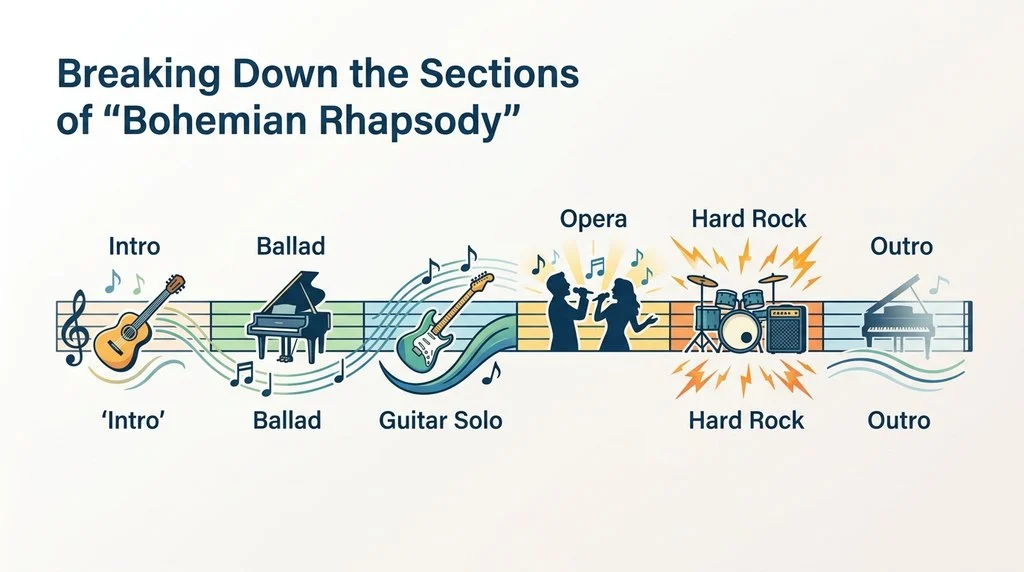
One fascinating way to understand the song is to look at its structure.
The Introductory Section
The song begins quietly and immediately creates uncertainty.
The narrator questions reality and his own situation.
This gives the listener the feeling of entering someone’s thoughts rather than simply hearing a conventional love song.
The atmosphere is intimate, mysterious, and vulnerable.
The Ballad Section
The song then develops into a more traditional ballad-like passage.
Here, the emotional story becomes clearer.
The narrator appears to confess something serious and struggles with fear, regret, and uncertainty.
This section is often viewed as the emotional foundation of the entire song.
The Guitar Solo
Brian May’s guitar solo acts almost like a bridge between different emotional worlds.
The vocals temporarily disappear, allowing the guitar to carry the emotion.
Rather than simply decorating the song, the solo helps prepare listeners for the dramatic change that follows.
The Operatic Section
This is arguably the most recognizable part of the song.
The opera-inspired section introduces a huge collection of theatrical vocal sounds and characters.
Words such as Galileo, Scaramouche, and Beelzebub add to the strange and dramatic atmosphere.
Some listeners interpret these references symbolically. Others see them as theatrical elements designed to create a surreal experience.
There is no universally confirmed dictionary-like explanation for every character or phrase.
The Rock Section
Suddenly, the delicate atmosphere disappears.
The song becomes loud, aggressive, and energetic.
This dramatic transformation can represent anger, rebellion, emotional release, or confrontation.
It also demonstrates Queen’s willingness to ignore conventional songwriting formulas.
The Ending
The song eventually returns to a calmer mood.
The ending feels almost detached after everything that came before it.
That contrast gives the song a sense of closure.
The emotional journey seems to move from uncertainty and fear toward resignation or acceptance.
Common Interpretations of “Bohemian Rhapsody”
Over the years, listeners have proposed many interpretations.
Here are some of the most commonly discussed ideas:
A Story About Murder and Guilt
One straightforward interpretation sees the narrator as someone who has committed a serious crime and is struggling with guilt.
The references to killing and facing consequences support this reading.
However, the lyrics do not provide enough detail to establish a literal crime story with certainty.
A Metaphorical Story About Personal Change
Another interpretation treats the song as a metaphor for a major transformation.
Under this reading, the narrator is leaving an old identity behind and confronting the emotional consequences of change.
The dramatic shifts in the music support this broader interpretation.
A Song About Sexual or Personal Identity
Another long-running interpretation connects the song to Freddie Mercury’s personal identity and sexuality.
Some listeners believe the lyrics contain coded references to coming to terms with his sexuality.
This theory has received significant attention because of Mercury’s private life.
However, Mercury did not publicly confirm a definitive interpretation along those lines, so it should be treated as an interpretation rather than established fact.
A Deliberately Surreal Musical Drama
There is also a simpler possibility: the song may intentionally avoid one literal meaning.
Mercury may have wanted to create something theatrical, emotional, and musically unpredictable rather than tell a single easily decoded story.
This interpretation fits the song’s unusual structure particularly well.
Why Is “Bohemian Rhapsody” So Difficult to Interpret?
Several things make the song unusually challenging.
The Lyrics Are Symbolic
Many lines don’t provide enough information to establish a literal storyline.
Instead, they create images, emotions, and dramatic tension.
The Music Changes Constantly
The song doesn’t remain in one genre.
It moves through ballad, opera, and rock influences.
Those changes can affect how listeners interpret the same lyrics.
Freddie Mercury Kept the Meaning Private
The lack of a definitive explanation created an enormous amount of speculation.
When an artist leaves a work open-ended, audiences naturally fill in the gaps.
Different Listeners Hear Different Stories
Someone might hear a song about guilt.
Another person might hear a song about identity.
Someone else might simply enjoy the theatrical performance.
All three experiences can coexist.
Common Misunderstandings About the Song
“There Must Be One Secret Meaning”
Not necessarily.
A complex artistic work doesn’t always have one hidden answer.
“Every Operatic Word Has a Secret Code”
The operatic lyrics contain references to historical, religious, and theatrical names, but that doesn’t mean every word forms a confirmed secret message.
Some interpretations are speculative.
“The Song Is Definitely About One Specific Event”
There is no universally accepted evidence establishing a single real-life event as the complete inspiration for the song.
“The Lyrics Are Just Random”
That’s also an oversimplification.
Even if the song isn’t a literal narrative, its lyrics clearly create themes of fear, guilt, conflict, pleading, and emotional release.
Why Does “Bohemian Rhapsody” Still Matter?
“Bohemian Rhapsody” remains influential because it challenged expectations about what a popular song could be.
In the 1970s, a long song with multiple sections and an extended operatic passage was far from conventional radio material.
Yet Queen turned those unusual elements into part of the song’s appeal.
Its enduring popularity also comes from its ability to create a different experience for different listeners.
You can enjoy it as:
- A rock song
- A theatrical performance
- A vocal showcase
- A mysterious story
- An emotional journey
- An example of ambitious songwriting
That flexibility helps explain why people continue discussing its meaning decades later.
How to Explain “Bohemian Rhapsody” in Simple Words
If someone asks you, “What is the meaning of Bohemian Rhapsody?”, you can give a simple answer:
“It is a dramatic and mysterious song about guilt, fear, inner conflict, and emotional acceptance, but Freddie Mercury never gave one definitive explanation of its lyrics.”
That’s probably the most useful short explanation.
It acknowledges the major themes without pretending that an uncertain interpretation is an established fact.
FAQs:
What is the main meaning of “Bohemian Rhapsody”?
The song is commonly interpreted as exploring guilt, fear, conflict, confession, and acceptance. However, Freddie Mercury did not publicly provide one definitive interpretation of the complete lyrics.
Why is it called “Bohemian Rhapsody”?
“Bohemian” can suggest an unconventional or artistic identity, while “rhapsody” describes a free-flowing musical composition. The title fits the song’s unconventional artistic structure.
Is “Bohemian Rhapsody” about Freddie Mercury’s life?
Various interpretations connect the lyrics with aspects of Mercury’s personal life, including identity and sexuality. However, there is no definitive statement from Mercury establishing one complete autobiographical meaning.
What does “Scaramouche” mean in “Bohemian Rhapsody”?
Scaramouche is a theatrical character associated with Italian commedia dell’arte. The reference contributes to the song’s theatrical and surreal atmosphere.
Why does “Bohemian Rhapsody” have an opera section?
The operatic passage is part of the song’s deliberately unconventional structure. It creates a dramatic transition between the ballad and rock sections and gives the composition its distinctive theatrical character.
Is there a hidden message in “Bohemian Rhapsody”?
Many theories suggest hidden meanings, but no single hidden message has been universally confirmed. The song’s ambiguity is an important part of its lasting appeal.
Final Thoughts:
The bohemian rhapsody meaning is best understood as an open-ended artistic experience rather than a puzzle with one officially confirmed answer. The song explores powerful emotions surrounding guilt, fear, conflict, identity, and acceptance while moving through several dramatically different musical styles.
That mystery is part of what makes “Bohemian Rhapsody” so enduring. Instead of telling listeners exactly what to think, Queen created a song that encourages people to form their own interpretations.
its lyrics and structure remain just as fascinating for new listeners as they were for audiences when the song first appeared.
If you have your own interpretation of “Bohemian Rhapsody,” share it in the comments and tell us which part of the song gives you the strongest clue about its meaning!

Hi, I’m Musaghumman, the mind behind EasyWordMeaning. I turn confusing words into easy meanings so anyone can learn, understand, and use English with confidence.