If you have seen the word “flyer” in a text, social media post, advertisement, or everyday conversation, you may have wondered exactly what it means.
The interesting thing about flyer is that it can have more than one meaning depending on the context. It may refer to a person or thing that flies, or it may describe a printed advertisement designed to spread information about an event, product, service, or promotion.
Understanding flyer meaning is useful because the word appears in everyday English, marketing, travel, business, and casual online conversations.
For example, someone might say, “I saw your flyer at the coffee shop,” while another person could say, “She is a talented flyer.” The surrounding words tell you which meaning is intended.
What Does “Flyer” Mean?
The word flyer has several meanings, but two are especially common.
1. Flyer Meaning: A Printed Advertisement
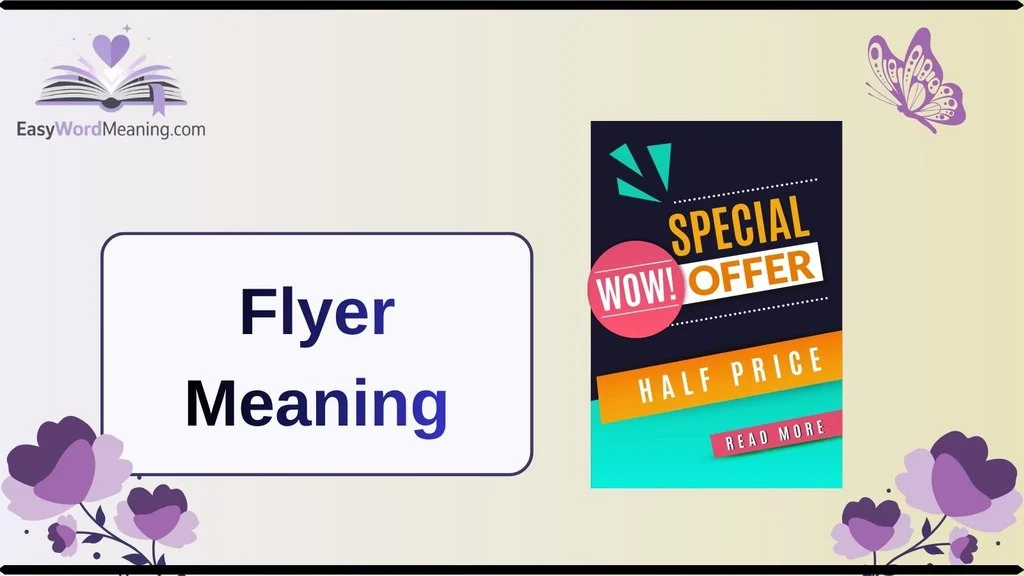
A flyer is a small printed sheet used to advertise or announce something. It can promote an event, sale, business, service, class, product, or community activity.
For example:
“I picked up a flyer for the school concert.”
Here, flyer means a piece of promotional or informational material.
Flyers are usually designed to catch attention quickly. They may include:
- A headline
- Pictures or graphics
- Event details
- A date and time
- A location
- Contact information
- A website or social media handle
- A special offer or discount
Today, the same concept can exist digitally. A business might create a promotional image and post it on Instagram, Facebook, WhatsApp, or another platform. People may still call that image a digital flyer.
2. Flyer Meaning: Someone or Something That Flies
Flyer can also refer to a person, animal, or thing that flies.
For example:
- “That bird is a fast flyer.”
- “She became a confident flyer after taking several lessons.”
- “The aircraft is an impressive flyer.”
In this sense, the word is connected to the verb fly.
The exact meaning depends heavily on the sentence. If someone says, “Send me the flyer,” they almost certainly mean an advertisement or information sheet. If someone says, “He is an experienced flyer,” they may be talking about someone who travels by airplane frequently.
Flyer Definition in Simple English
In simple terms, flyer can mean:
A flyer is either a promotional sheet used to share information or, in some contexts, a person or thing that flies.
The first meaning is particularly common in advertising and everyday conversation.
Think of a flyer as a quick visual message. Instead of explaining an event to every person individually, someone can create one flyer containing the important information and distribute it to many people.
For example, a gym might create a flyer announcing:
“Summer Fitness Classes — Register Today!”
A school could make one for a fundraiser, while a restaurant might use one to advertise a weekend discount.
Where Does the Word “Flyer” Come From?
The word flyer is related to the English verb fly, which has a very long history in the language.
The spelling and usage of flyer have developed over time, and English also uses the spelling flier. Both forms can be found in dictionaries and standard English, although usage can vary depending on the meaning, region, and style guide.
The advertising sense of flyer developed around the idea of something that could be distributed quickly or widely. Historically, promotional sheets could be handed out to large numbers of people, making them an efficient way to spread information.
Today, the concept has evolved with technology. A flyer does not necessarily have to physically “fly” anywhere. A digital flyer can be shared with hundreds or thousands of people with a few clicks.
Flyer vs. Flier: What’s the Difference?
One of the most common questions about this word is whether flyer and flier mean the same thing.
The answer is: sometimes, but spelling preferences vary.
Both flyer and flier can be used for a person or thing that flies. However, flyer is especially common for a promotional handbill or advertisement.
For example:
- “The store created a flyer for its weekend sale.”
→ Promotional advertisement - “He is a frequent flier.”
→ Someone who travels by airplane frequently
The expression frequent flier is especially well established in travel-related English.
Is “Flyer” or “Flier” Correct?
Both spellings can be correct, depending on context and regional preference.
A useful rule is:
- Flyer → very common for advertisements and promotional sheets.
- Flier → often seen in expressions such as “frequent flier.”
- Flyer and flier → can both refer to someone or something that flies.
If you are writing marketing content, flyer is the familiar choice for a promotional handout.
How Is “Flyer” Used in Everyday Conversations?
The word flyer is common in everyday English, particularly when people discuss events, shopping, advertising, or promotions.
Here are some natural examples:
- “Did you see the flyer for the concert?”
- “Someone left a flyer on my desk.”
- “The restaurant is handing out flyers.”
- “Can you send me the event flyer?”
- “I found a flyer advertising a photography class.”
- “The store’s new flyer has some great deals.”
- “They posted the flyer online.”
- “We need to print 200 flyers before Friday.”
Notice how the context makes the meaning clear.
How to Use “Flyer” in Texts or Chats
Although flyer is not normally a texting abbreviation or internet slang term, it is frequently used in casual digital communication.
People may mention a flyer when sharing information about an event or promotion.
Example 1: Event Planning
Person A: Are we still having the charity event Saturday?
Person B: Yep! I’ll send you the flyer with all the details.
Here, the flyer probably contains the event’s time, location, and other information.
Example 2: Business Promotion
Person A: What are you advertising this week?
Person B: We’re making a flyer for our new discount.
Again, flyer means promotional material.
Example 3: Social Media
Person A: Did you make the Instagram post?
Person B: Not yet. I’m designing the flyer now.
In this modern context, “flyer” may refer to a digital promotional graphic rather than a physical sheet of paper.
Example 4: School Event
Student A: When is the science fair?
Student B: Check the flyer our teacher posted in the group chat.
The flyer acts as a quick information source.
Digital Flyer Meaning
The internet has changed how people think about flyers.
Traditionally, a flyer was a physical piece of paper. Today, a digital flyer can be an image, PDF, graphic, or online advertisement shared electronically.
Digital flyers are common on:
- School websites
- Business websites
- Online community groups
- Messaging apps
For example, a local restaurant might design a digital flyer showing its new menu promotion and upload it to social media.
A digital flyer can be especially useful because it is easy to share. One person can forward it to several friends, who can then share it with others.
Common Types of Flyers
Flyers can be created for almost any purpose.
Event Flyers
These promote events such as:
- Concerts
- School activities
- Workshops
- Sports events
- Community gatherings
- Fundraisers
- Festivals
Business Flyers
Businesses often use flyers to promote:
- New products
- Discounts
- Services
- Grand openings
- Seasonal sales
- Special offers
Educational Flyers
Schools, colleges, and organizations may use flyers to explain:
- Upcoming activities
- Important announcements
- Courses
- Workshops
- Safety information
- Community programs
Promotional Flyers
These are designed specifically to encourage people to take action, such as visiting a store, signing up for a service, or attending an event.
Examples of “Flyer” in Different Contexts
Context is important when understanding flyer meaning. Here are some examples.
Advertising
“The company distributed flyers around the neighborhood.”
Meaning: The company distributed promotional sheets.
Social Media
“I uploaded the new event flyer to Instagram.”
Meaning: A digital promotional graphic was uploaded.
Travel
“She is a frequent flier.”
Meaning: She frequently travels by airplane.
Aviation
“The aircraft is an excellent flyer.”
Meaning: The aircraft performs well in flight.
Animals
“The eagle is an impressive flyer.”
Meaning: The eagle is skilled or capable at flying.
Common Mistakes and Misunderstandings
Because flyer has multiple meanings, it can occasionally cause confusion.
Mistake 1: Assuming Every “Flyer” Is an Advertisement
Not every use of flyer refers to marketing.
For example:
“He is a talented flyer.”
This could describe someone who flies, depending on the context.
Mistake 2: Confusing “Flyer” With “Frequent Flier”
A frequent flier is a person who travels by airplane often.
For example:
“My uncle is a frequent flier because his job requires a lot of travel.”
This is different from:
“The store printed a flyer for its sale.”
The first refers to air travel; the second refers to promotional material.
Mistake 3: Thinking Flyer Is Internet Slang
Flyer is not generally an internet slang abbreviation. It is a standard English word.
It can certainly appear in texts, comments, social media posts, and group chats, but its meaning usually remains the ordinary dictionary meaning determined by context.
Mistake 4: Assuming Digital Flyers Aren’t Flyers
A flyer does not have to be printed.
An Instagram graphic promoting an event can reasonably be called a digital flyer. The format has changed, but the basic purpose—quickly communicating information—remains similar.
Flyer Meaning in Marketing
In marketing, a flyer is a simple promotional tool designed to communicate a message quickly.
A good flyer generally answers important questions such as:
What is being offered?
When is it happening?
Where is it happening?
Why should people care?
How can they participate or learn more?
For example, imagine a local bakery promoting a weekend sale. Its flyer might include the sale dates, featured products, discount information, store address, and contact details.
The goal is not necessarily to tell the customer everything about the business. Instead, the flyer gives them the most useful information at a glance.
Why Are Flyers Still Used?
Even though social media and digital advertising are everywhere, flyers remain useful because they are simple and easy to understand.
Some advantages include:
- Easy to share: Digital flyers can be forwarded instantly.
- Visually appealing: Images and headlines can attract attention.
- Affordable: Basic flyers can be inexpensive to produce.
- Flexible: They can advertise almost anything.
- Easy to customize: Businesses can create different flyers for different audiences.
- Useful offline: Printed flyers can reach people who may not see an online advertisement.
The modern flyer has essentially become a bridge between traditional advertising and digital communication.
Funny and Relatable Flyer Examples
Sometimes the word appears in casual situations that are more humorous than professional.
Imagine receiving this message:
“I made a flyer for my birthday party. Please admire it before you ask what time it starts.”
Or:
“The flyer has the date, time, and location. Please don’t make me explain all three in the group chat.”
And the classic group-chat situation:
“READ THE FLYER 😭”
That last example captures why flyers are useful: all the important information is supposed to be in one place.
Related Words and Terms
If you are learning the meaning of flyer, these related terms are also useful.
Flier
An alternative spelling of flyer, commonly seen in expressions such as frequent flier.
Handbill
A small printed sheet distributed to people, often for advertising or announcements.
Leaflet
A small printed publication or sheet containing information or advertising.
Brochure
A more detailed promotional or informational publication, often folded into sections.
Poster
A larger printed or digital display designed to attract attention and communicate information.
Advertisement
A message intended to promote a product, service, event, or idea.
Promotion
An activity or offer designed to encourage interest in a product, service, or event.
FAQs:
What does flyer mean in simple words?
A flyer is usually a small advertisement or information sheet. It can also describe a person, animal, or thing that flies, depending on context.
Is flyer slang?
No. Flyer is a standard English word, not normally a slang abbreviation. It can be used in casual texts and social media, but its meaning depends on the context.
What is a flyer used for?
Flyers are commonly used to advertise events, businesses, products, services, sales, classes, and community activities.
Is a digital flyer still a flyer?
Yes. A digital flyer can serve the same purpose as a printed flyer. It may be shared through social media, email, websites, or messaging apps.
What is the difference between flyer and flier?
Both spellings can refer to someone or something that flies. Flyer is particularly common for promotional material, while flier frequently appears in the expression frequent flier.
What does “frequent flier” mean?
A frequent flier is someone who travels by airplane regularly or often.
Can flyer refer to a person?
Yes. In some contexts, flyer can describe a person who flies, although flier is also commonly used for this meaning.
What does “send me the flyer” mean?
It normally means “send me the promotional or informational sheet.” In a digital conversation, this could be an image, PDF, or graphic.
Final Thoughts:
The meaning of flyer is surprisingly flexible. Most often, it refers to a printed or digital piece of promotional or informational material, but it can also describe a person or thing that flies. Context is the key to understanding which meaning is intended.
In today’s digital world, flyers are no longer limited to pieces of paper handed out on streets. Businesses, schools, event organizers, and individuals can create digital flyers and share them instantly through social media, email, and messaging apps.
Now that you know the different meanings of flyer, you should be able to recognize the word confidently in texts, conversations, advertisements, and online posts.
Share your favorite English word or text abbreviation in the comments!

Hi, I’m Musaghumman, the mind behind EasyWordMeaning. I turn confusing words into easy meanings so anyone can learn, understand, and use English with confidence.