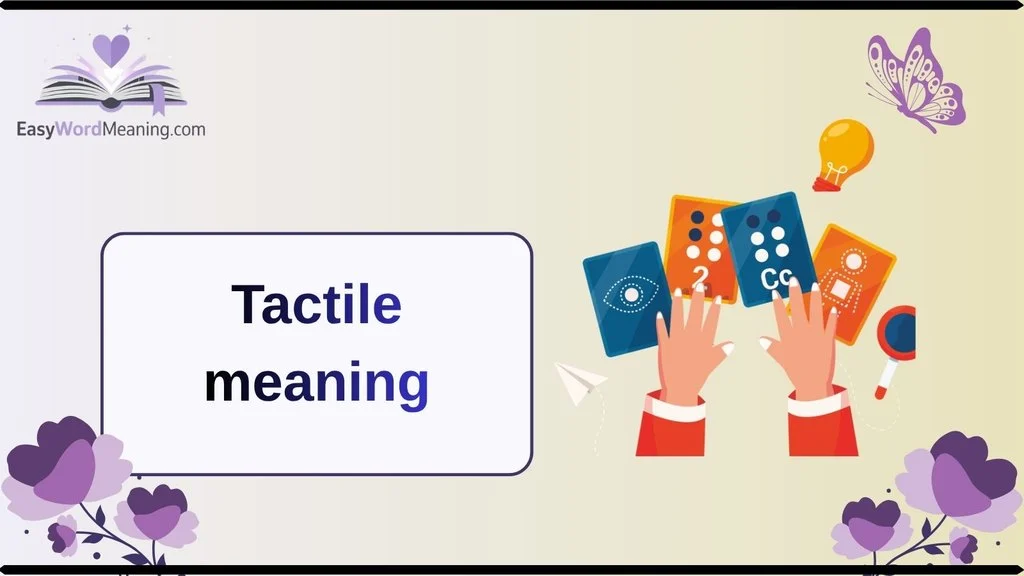
Have you ever heard someone describe something as tactile and wondered what they meant? You may see the word in conversations about touch, fabrics, design, technology, learning, art, or even personal experiences. While it can sound a little formal, its basic meaning is quite simple.
Tactile means related to the sense of touch or something that can be felt by touching it. For example, the soft texture of a blanket is tactile, as is the raised lettering on a sign that you can feel with your fingers.
Understanding tactile meaning is useful because the word appears in everyday writing, product descriptions, education, psychology, technology, and social media discussions.
What Does Tactile Mean?

The word tactile means connected with the sense of touch.
In simple terms, if something involves touching, feeling, or physically experiencing a surface or object, it can be described as tactile.
Tactile Meaning in Simple English
A simple definition is:
Tactile means something that can be felt through touch or that relates to the sense of touch.
For example:
- A soft sweater has a tactile quality.
- A rough stone has a tactile surface.
- Braille is tactile because people read it by touching raised dots.
- A touchscreen provides a tactile experience when you interact with it.
- Clay is a tactile material because you can physically shape and feel it.
So, when someone says, “I like the tactile feel of this material,” they mean they enjoy how the material feels when they touch it.
What Is the Origin of the Word Tactile?
Tactile comes from the Latin word tactilis, meaning “that which may be touched.” It is related to the Latin verb tangere, meaning “to touch.”
The word entered English as a way to describe things connected with physical touch.
That basic idea has remained consistent. Today, you can find tactile used in many different fields, from product design to education and accessibility.
Tactile vs. Touch
The words tactile and touch are closely related, but they are not always used in exactly the same way.
Touch can refer to the physical act or sense itself.
Tactile is an adjective used to describe something associated with touch.
For example:
- Touch: “I touched the fabric.”
- Tactile: “The fabric has a pleasant tactile texture.”
Think of it this way: touch is the sense or action, while tactile describes something connected to that sense.
How to Use Tactile in a Sentence
The word tactile is usually used as an adjective. It often comes before a noun such as experience, sensation, feedback, surface, texture, or quality.
Here are some natural examples:
- “The wooden toy has a wonderful tactile quality.”
- “Children often learn through tactile activities.”
- “The fabric gives the product a soft tactile feel.”
- “The keyboard provides tactile feedback.”
- “I prefer books because I enjoy the tactile experience of turning pages.”
You can also use it when talking about physical interaction with objects.
Common Tactile Phrases
Some phrases appear frequently in everyday and professional writing:
- Tactile experience
- Tactile sensation
- Tactile feedback
- Tactile surface
- Tactile texture
- Tactile learning
- Tactile response
- Tactile material
- Tactile design
- Tactile interaction
Each phrase connects an experience, object, or process with the sense of touch.
What Is a Tactile Experience?
A tactile experience is an experience involving physical touch or the sensation of an object’s texture, shape, weight, or surface.
For instance, opening a hardcover book, running your fingers across textured paper, or squeezing a stress ball can all be described as tactile experiences.
Everyday Examples of Tactile Experiences
You probably have tactile experiences every day without thinking about them.
Consider:
- Walking barefoot across sand.
- Holding a warm mug.
- Petting a dog.
- Touching a smooth phone screen.
- Feeling the texture of denim.
- Kneading bread dough.
- Holding a freshly printed book.
- Running your hand over tree bark.
These experiences give your brain information through physical touch.
What Does Tactile Mean in Psychology?
In psychology and related fields, tactile generally refers to sensations or information received through the sense of touch.
Our sense of touch helps us understand the world around us. When you pick up an object, your skin and nervous system can provide information about its temperature, texture, pressure, shape, and other physical qualities.
For example, you might touch a cup and immediately recognize that it is:
- Smooth
- Warm
- Hard
- Rounded
- Heavy
That information is part of tactile perception.
Tactile Sensation
A tactile sensation is the feeling you receive through physical contact.
Imagine touching a fluffy blanket. Your skin detects its softness and texture. That physical information is a tactile sensation.
The same idea applies when you touch something cold, rough, sticky, smooth, or vibrating.
What Does Tactile Mean in Education?
In education, tactile learning refers to learning activities that involve physical interaction and hands-on experiences.
Some learners benefit from physically handling objects while learning a concept. Instead of only reading or listening, they can touch, move, build, arrange, or manipulate something.
Examples include:
- Using physical blocks to learn mathematics.
- Shaping letters from clay.
- Handling science models.
- Using puzzles to understand shapes.
- Practicing handwriting.
- Building models for a classroom project.
The word tactile in this context emphasizes hands-on interaction.
What Does Tactile Mean in Technology?
You may also encounter tactile when reading about phones, keyboards, gaming controllers, and other electronic devices.
One common phrase is tactile feedback.
Tactile Feedback Meaning
Tactile feedback is physical feedback you can feel when interacting with a device.
For example, your phone may vibrate when you tap a button. A gaming controller may vibrate when something happens in a game. A keyboard switch may provide a noticeable physical response when you press a key.
That physical sensation helps confirm that an action has occurred.
A simple example would be:
“This keyboard has strong tactile feedback.”
The speaker means that the keys provide a noticeable physical sensation when pressed.
What Does Tactile Mean in Design?
Designers often use the word tactile when discussing how a product feels in someone’s hands.
A product may look attractive, but its physical feel can also influence how people experience it.
For example, imagine two phone cases. One feels completely smooth and slippery, while the other has a textured surface that is easier to grip.
The second case could be described as having a more tactile design.
Tactile design can involve:
- Texture
- Shape
- Weight
- Surface finish
- Materials
- Grip
- Physical controls
This is particularly important for products people handle frequently.
What Does Tactile Mean in Accessibility?
The word tactile is also important when discussing accessibility.
A tactile feature allows people to receive information through touch. One familiar example is Braille, which uses raised dots that can be read through touch.
Other examples may include:
- Raised symbols
- Textured signs
- Tactile maps
- Buttons with physical markings
- Raised numbers
- Textured warning surfaces
These features can make information easier to access without relying entirely on vision.
Tactile Examples in Everyday Conversations
Although tactile is not usually slang, it can appear in casual conversations, especially when someone is describing how something feels.
Here are some realistic examples.
Example 1: Talking About Clothes
Alex: “How do you like this jacket?”
Sam: “I love it. The material has such a nice tactile feel.”
Here, Sam is talking about how the jacket feels to the touch.
Example 2: Talking About Books
Mia: “Why do you still buy physical books?”
Jordan: “I just like the tactile experience. Reading on a screen isn’t quite the same.”
Here, tactile experience refers to physically holding and interacting with a book.
Example 3: Talking About Technology
Chris: “How’s the new keyboard?”
Ryan: “Pretty good. I like the tactile feedback from the keys.”
Ryan is describing the physical sensation produced when pressing the keys.
Example 4: Talking About Food
Emma: “What do you like about making bread?”
Liam: “Honestly, I love the tactile part of kneading the dough.”
In this example, tactile describes the physical sensation of working with the dough.
Tactile Meaning on Social Media and in Texting
You may occasionally see tactile used in social media posts, captions, reviews, or online discussions.
For example:
“This sweater is so soft. I love the tactile feel.”
Or:
“I miss the tactile experience of writing with a real pen.”
Or:
“The game controller has great tactile feedback.”
Unlike abbreviations such as LOL, BRB, or IDK, the word tactile is not generally a texting abbreviation or internet slang term.
It is a standard English adjective that can be used in both casual and formal communication.
Common Mistakes About Tactile
Because tactile sounds somewhat technical, people sometimes misunderstand its meaning.
Tactile Does Not Mean “Physical” in Every Situation
Tactile specifically relates to touch or the sense of touch.
For example, saying:
“The building is tactile.”
would usually sound incomplete or unusual unless you explain what aspect involves touch.
A better sentence might be:
“The building has tactile surfaces that help visitors navigate the space.”
Tactile Does Not Mean “Beautiful”
Something can have a beautiful design without being tactile.
A painting may look beautiful, but calling it tactile would suggest that its physical texture or touch is relevant.
Tactile Is Not the Same as Tangible
These words are related but different.
Tangible generally means something that can be physically touched or clearly exists in a concrete form.
Tactile focuses more specifically on the sense of touch or the experience of touching something.
For example:
- “The company produced a tangible product.”
- “The product has a pleasant tactile surface.”
The distinction is small but useful.
Tactile vs. Tangible: What’s the Difference?
Here is a quick comparison:
| Word | Basic Meaning | Example |
|---|---|---|
| Tactile | Related to touch | “The fabric has a tactile texture.” |
| Tangible | Physically real or touchable | “The company created a tangible product.” |
| Touch | The physical sense or action | “I touched the fabric.” |
| Texture | The way a surface feels | “The texture is rough.” |
A useful memory trick is:
Tactile = touch-related.
Tangible = physically real or concrete.
Synonyms for Tactile
Depending on the sentence, several words can communicate a similar idea.
Possible alternatives include:
- Touch-based
- Touch-related
- Physical
- Hands-on
- Sensory
- Textured
- Touchable
- Haptic
However, these words are not always perfect replacements.
For example, haptic is commonly used for technology and physical feedback, while hands-on often refers to active participation rather than simply touching something.
What Is the Opposite of Tactile?
There is no single opposite of tactile that works in every sentence.
Depending on context, you might use:
- Visual
- Auditory
- Non-physical
- Digital
- Abstract
For example, a visual experience primarily involves sight, while a tactile experience primarily involves touch.
In learning, you might compare tactile activities with activities based mainly on listening or visual observation.
How to Remember the Meaning of Tactile
If you have trouble remembering the word, connect it with touch.
A simple memory trick is:
Tactile → Touch
Both words describe the experience of physically feeling something.
You can also remember common phrases such as:
- Tactile feedback = feedback you can feel
- Tactile texture = texture you can feel
- Tactile experience = an experience involving touch
- Tactile learning = learning through hands-on interaction
Once you remember that connection, the word becomes much easier to understand.
FAQs:
What is the simple meaning of tactile?
Tactile means related to the sense of touch. It can describe something you feel physically, such as a rough surface, soft fabric, raised lettering, or vibration from a device. In simple English, if something involves how an object feels when you touch it, “tactile” is often an appropriate word.
What is an example of tactile?
A simple example is a soft blanket. Its softness can be felt through touch, so you could describe its texture as tactile. Other examples include Braille, textured packaging, a vibrating phone, a keyboard with noticeable key feedback, and hands-on classroom materials.
Is tactile the same as touch?
They are closely related, but they are used differently in a sentence. Touch can be a noun or verb describing the sense or action. Tactile is an adjective describing something connected with touch. For example, “I touched the fabric” describes an action, while “The fabric has a tactile texture” describes the fabric.
What does tactile feedback mean?
Tactile feedback means physical feedback that you can feel. A phone vibrating after you tap a button is a simple example. A keyboard key that gives you a noticeable physical response can also provide tactile feedback. The physical sensation helps you recognize that an interaction has occurred.
What is tactile learning?
Tactile learning involves using physical touch and hands-on activities while learning. A student might build a model, manipulate objects, shape letters, or use physical materials to understand a concept. The key idea is that learning involves physical interaction rather than relying only on reading, watching, or listening.
What is the difference between tactile and tangible?
Tactile specifically relates to touch and the sensation of touching something. Tangible generally means physically real, concrete, or capable of being touched. A physical product can be tangible, while the product’s texture or feel can be described as tactile.
Is tactile a slang word?
No. Tactile is not normally considered internet slang or a texting abbreviation. It is a standard English adjective. People may use it in casual texts, social media posts, product reviews, and online conversations, but its meaning remains connected to touch.
What is a synonym for tactile?
Depending on context, possible alternatives include touch-related, touch-based, hands-on, sensory, textured, and haptic. The best choice depends on the sentence. “Haptic,” for example, is especially common when discussing technology and physical feedback.
Final Thoughts:
The simplest way to remember tactile meaning is: tactile means related to touch. It can describe the feeling of a material, a hands-on activity, physical feedback from technology, or information received through touch.
You may encounter the word in everyday conversations, product descriptions, education, accessibility, design, technology, and online discussions. Once you connect tactile with touch, its different uses become much easier to understand.
If you found this explanation helpful, share it with someone who has wondered what “tactile” means. Share your favorite word or text abbreviation in the comments!

Hi, I’m Musaghumman, the mind behind EasyWordMeaning. I turn confusing words into easy meanings so anyone can learn, understand, and use English with confidence.