Have you ever seen a word with a line through it in a text, email, or social media post and wondered what it actually meant?
That little line isn’t just decorative—it’s a powerful way to convey tone, emotion, or even humor in digital communication.
Understanding strikethrough meaning is essential if you want to communicate effectively in 2026’s fast-paced texting, chat, and online culture.
Whether you’re sending a casual message to a friend, posting on social media, or writing in professional environments, knowing how and when to use strikethrough can elevate your writing, make your messages clearer, and even add a touch of personality.
this article, we’ll explore the definition, usage, examples, mistakes, and related slang so you can master strikethrough like a pro.
💡 Quick Joke Box:
Why did the word get a strikethrough?
Because it needed to cross some things off its list! 😎
What Does “Strikethrough” Mean? (Definition & Origin) 📝
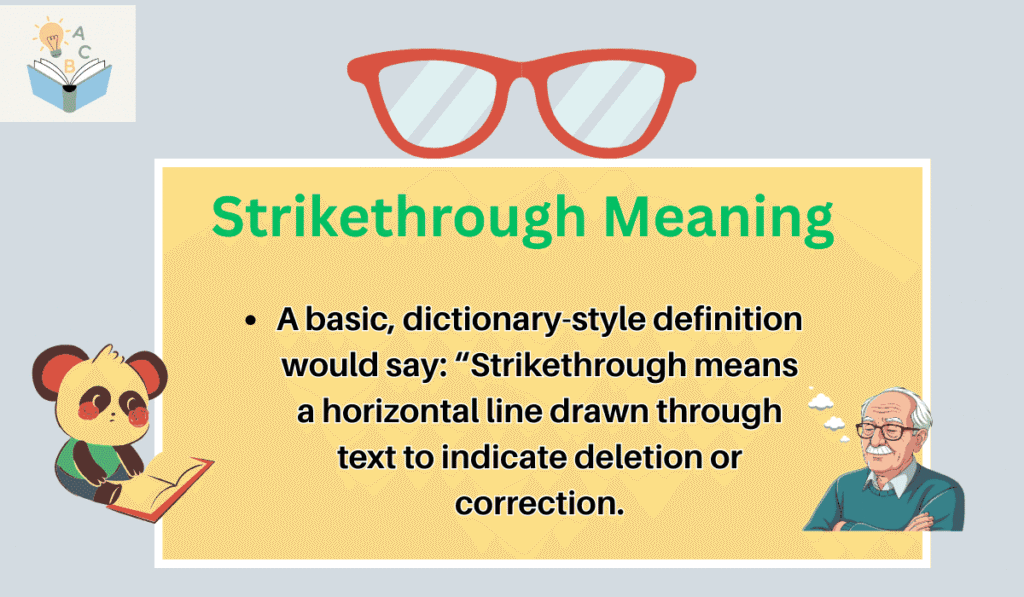
Strikethrough refers to a typographical style where a horizontal line is drawn through the center of a word or phrase. In essence, it visually indicates that something is no longer valid, relevant, or needs emphasis in a humorous or sarcastic way.
Origin of Strikethrough
- The strikethrough format has been around since the early days of typewriters and word processors. It was initially used in editing and proofreading to indicate deletion without removing the text completely.
- In digital culture, strikethrough has evolved to express sarcasm, irony, correction, or humor. Think of it as a subtle eye-roll in text form.
- With platforms like Microsoft Word, Google Docs, Discord, Reddit, and WhatsApp, strikethrough has become widely accessible and trendy in online messaging.
Quick insight: Using strikethrough in casual chats often conveys personality, like saying, “Oops, I changed my mind!” without actually erasing the text.
How to Use “Strikethrough” in Texts or Chat 💬
Using strikethrough can be fun, expressive, and useful—but only if you know the right contexts. Here’s how to do it across platforms:
1. Messaging Apps
- WhatsApp: Type
~text~to strikethrough your words. Example:~oops~ never mind! - Telegram & Discord: Markdown formatting works with
~~text~~. Example:~~I failed~~ I mean I passed!
2. Social Media
- Platforms like Twitter/X, Reddit, and Facebook allow strikethrough via Markdown or formatting tools. It’s perfect for humor or sarcastic posts.
Example: “I ~hate~ love Mondays.”
3. Professional Documents
- In Word, Google Docs, and Excel, select the text and apply the strikethrough option. Use it for edits or updates without deleting the original text.
- Example in docs: “Complete the report by Friday
ThursdayFriday.”
Pro Tip: Strikethrough works best when paired with humor or subtle commentary—it adds a layer of meaning without extra words.
Examples of “Strikethrough” in Conversations 📱
Seeing strikethrough in action makes it much easier to understand. Here are some relatable, real-world examples:
Casual Chat
- Friend: “Are you coming to the party tonight?”
- You: “I ~probably won’t~ definitely will! 😅”
Social Media Post
- “I’m ~definitely~ not addicted to coffee… okay, maybe a little.” ☕
Work or Study Group
- “Submit your assignment by ~Wednesday~ Friday. Don’t make me strikethrough this again!”
Humor and Sarcasm
- “I ~love~ hate running… especially in the morning.”
- “I ~worked~ barely survived this week!”
💡 Pro Tip: Using strikethrough in memes or tweets can dramatically boost engagement—it’s a subtle way of showing personality.
Common Mistakes or Misunderstandings ⚠️
Even though strikethrough is simple, people often misuse it. Here’s what to watch out for:
- Overusing it – Too many crossed-out words can make your message confusing or visually messy.
- Misinterpreting tone – Strikethrough often conveys sarcasm or humor, so be cautious in professional contexts.
- Technical errors – Not all platforms support strikethrough syntax. Double-check before posting.
- Incorrect placement – Using strikethrough on the wrong word can change the meaning completely.
Related Slangs or Abbreviations 🔗
Strikethrough often appears alongside other modern texting tools and abbreviations:
- LOL / LMAO / ROFL – Expressing laughter with strikethrough adds sarcastic or self-deprecating humor.
Example: “I ~totally~ didn’t just spill coffee on my laptop. LOL” - SMH (Shaking My Head) – Pairing with strikethrough intensifies irony: “I ~thought~ knew better. SMH.”
- BRB / TTYL – Sometimes strikethrough is used in playful edits: “BRB ~maybe~ definitely.”
- Markdown & Emotes – Using
~~text~~plus emojis can make strikethrough fun and readable.
Updated for 2026: Why Strikethrough Still Matters 🚀
Even as texting and online communication evolve, strikethrough remains trendy, versatile, and relevant. Whether you’re:
- Creating viral tweets or Instagram captions,
- Sending funny messages in Discord or WhatsApp groups, or
- Editing professional documents without deleting history,
…strikethrough adds clarity, humor, and personality to your digital language.
💡 Example:
“I ~failed~ aced the meeting!” – conveys humor and triumph in one quick glance.
Conclusion :✨
In 2026, understanding strikethrough meaning isn’t just about typography—it’s about mastering tone, humor, and digital communication.
By knowing how to use strikethrough correctly in texts, social media, or documents, you can:
- Add personality and humor to messages
- Highlight corrections or changes without erasing your thoughts
- Avoid common mistakes and make your communication clearer
💬 Call-to-Action: Share your favorite text abbreviation or funniest strikethrough example in the comments below!

Suleman Malik is the voice behind EasyWord Meaning, bringing clarity to words one meaning at a time. Passionate about language and learning, he makes understanding words simple, fun, and memorable for everyone.