
Understanding everyday English words can make texting, social media conversations, and casual chats much easier. One word that often causes confusion is regardless. You may see it in messages, comments, emails, school assignments, or online discussions and wonder exactly what it means or how to use it naturally.
In simple terms, regardless meaning is “despite that,” “even though,” or “no matter what.” It is commonly used when something remains true or happens despite another fact or situation.
For example: “It was raining, but we went outside regardless.” Here, regardless means they went outside despite the rain.
What Does Regardless Mean?
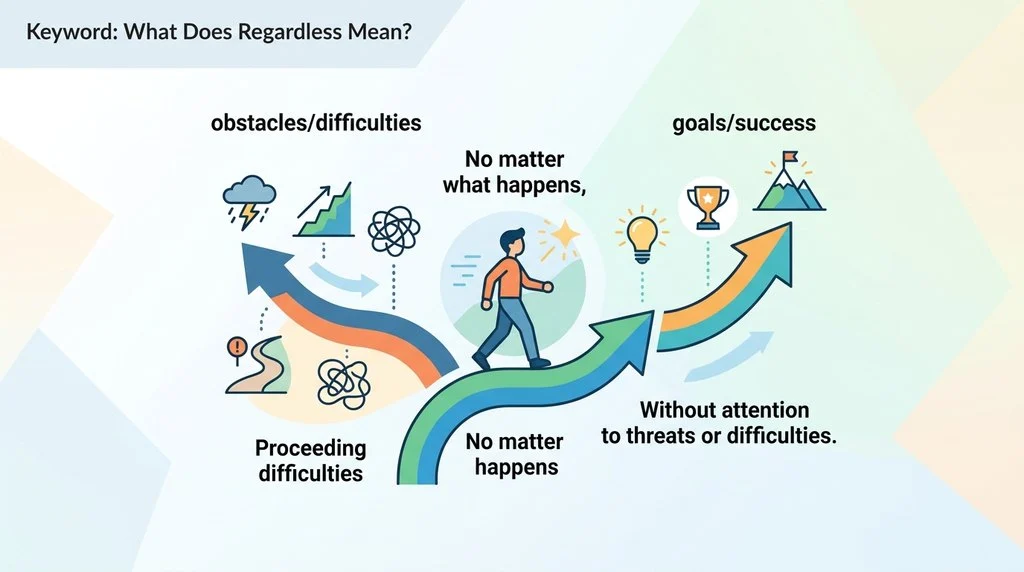
Regardless means without being affected by something else, or despite a particular situation.
It tells the reader that one fact does not change the outcome.
Simple Definition
The easiest way to understand regardless is:
Regardless = despite that / no matter what / anyway
For example:
- “I’m going regardless.”
→ I’m going no matter what. - “She continued working regardless of the noise.”
→ She continued working despite the noise. - “You can choose whichever option you want. I’ll support you regardless.”
→ I’ll support you no matter what you choose.
The word is useful when you want to emphasize that something will happen or remain true even when circumstances might suggest otherwise.
Regardless Meaning in Texting
In texting, regardless usually has the same meaning it has in standard English. It is not normally an acronym or secret internet abbreviation.
Someone might text:
“I know it’s expensive, but I want it regardless.”
This means:
“I know it’s expensive, but I still want it anyway.”
You may also see shorter, casual expressions such as:
- Anyway
- No matter what
- Either way
- Still
- Despite that
- Even so
Example in a Text Conversation
Alex: The weather looks terrible tomorrow.
Sam: I know, but I’m going regardless.
Here, Sam means that the bad weather will not change the decision.
What Does “Regardless of” Mean?
One of the most common structures is regardless of.
Regardless of means despite or without considering something as a factor.
Examples
- “We will continue regardless of the weather.”
- “She treats everyone kindly regardless of their background.”
- “I’ll finish the project regardless of how long it takes.”
- “He went to the event regardless of the criticism.”
In each example, the situation after regardless of does not change what happens.
Regardless of vs. Despite
These expressions are often interchangeable.
Regardless of the weather, we went hiking.
Despite the weather, we went hiking.
Both communicate a similar idea: the weather did not prevent the hiking trip.
What Is the Origin of Regardless?
The word regardless comes from the combination of regard and the suffix -less.
The word regard can relate to consideration or attention. The suffix -less means “without.”
So, in a literal sense, regardless carries the idea of without regard or consideration.
Over time, it developed into its modern meaning: something happens without being influenced by a particular condition or circumstance.
Today, regardless is a standard English word used in both formal and informal communication.
How to Use Regardless in a Sentence
There are several natural ways to use regardless.
1. Use “regardless” at the End
This is common in everyday conversation.
Example:
“It might be difficult, but I’m going regardless.”
Meaning: I’m going anyway.
Another example:
“I probably shouldn’t order dessert, but I’m getting the cake regardless.”
That is a very relatable use of the word!
2. Use “regardless of” Before a Noun
Use regardless of + noun when you want to say that something does not affect the outcome.
Examples:
- “She smiled regardless of the situation.”
- “We will play regardless of the weather.”
- “He continued regardless of the consequences.”
3. Use “regardless of whether”
This structure is useful when discussing two possible situations.
Examples:
- “I’ll attend regardless of whether you come.”
- “We have to finish the work regardless of whether it is easy or difficult.”
- “She plans to travel regardless of whether her friends join her.”
The meaning is essentially “in either situation.”
Regardless Meaning With Examples
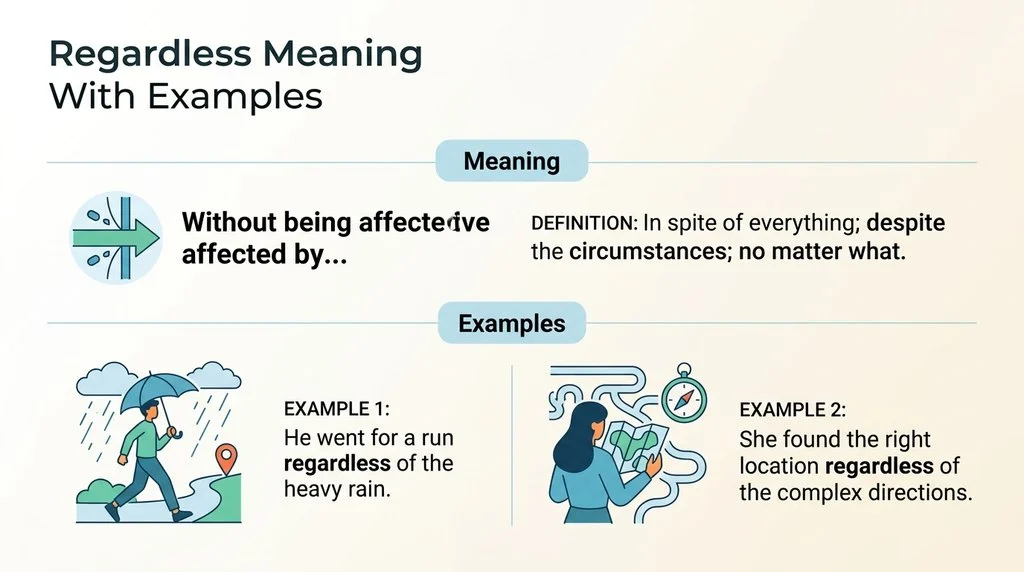
Here are some simple examples from everyday situations.
Example 1: Plans
“The tickets are expensive, but I’m going regardless.”
Meaning: The price will not change the decision.
Example 2: Weather
“It may rain tomorrow, but we’re going hiking regardless.”
Meaning: The hiking plan will continue even if it rains.
Example 3: Friendship
“We don’t always agree, but I respect you regardless.”
Meaning: The disagreement does not change the speaker’s respect.
Example 4: Work
“The task is challenging, but we need to complete it regardless.”
Meaning: The difficulty does not change the requirement.
Example 5: Social Media
“People may disagree with my opinion, but I’ll share it regardless.”
Meaning: Other people’s disagreement will not stop the speaker.
Regardless in Texting and Social Media
Modern online conversations often use regardless when someone wants to emphasize that something does not change their decision.
You might find it in:
- Text messages
- Instagram captions
- TikTok comments
- Facebook posts
- Reddit discussions
- Discord chats
- Online forums
- Emails
- Group chats
Casual Texting Examples
Friend: You really want to watch that movie again?
You: Yep 😂 I love it regardless.
Friend: Everyone else canceled.
You: I’m going regardless.
Friend: The restaurant has terrible reviews.
You: I still want to try it regardless.
Friend: You know you might regret buying that, right?
You: Probably, but I’m buying it regardless. 😂
These examples show that the word can sound perfectly natural in casual conversation.
Is Regardless Formal or Informal?
Regardless works in both formal and informal English.
It is not limited to texting slang.
For example, it can appear in a casual message:
“I’m coming regardless.”
But it can also appear in professional writing:
“The policy applies regardless of the employee’s position.”
This flexibility makes regardless a useful word to know.
Where You Can Use It
You can generally use it in:
- Casual conversations
- Text messages
- Professional emails
- Academic writing
- Articles
- Reports
- Social media
- Online discussions
The surrounding sentence determines whether the overall tone sounds casual or formal.
Regardless vs. Irregardless
This is one of the biggest points of confusion.
Is “Irregardless” a Word?
Irregardless is widely used in speech, but it is generally considered nonstandard or controversial in formal English.
The standard choice is:
Regardless
For example:
✅ “I’ll do it regardless.”
Instead of:
⚠️ “I’ll do it irregardless.”
If you want your writing to sound polished and standard, regardless is the safer choice.
Regardless vs. Anyway
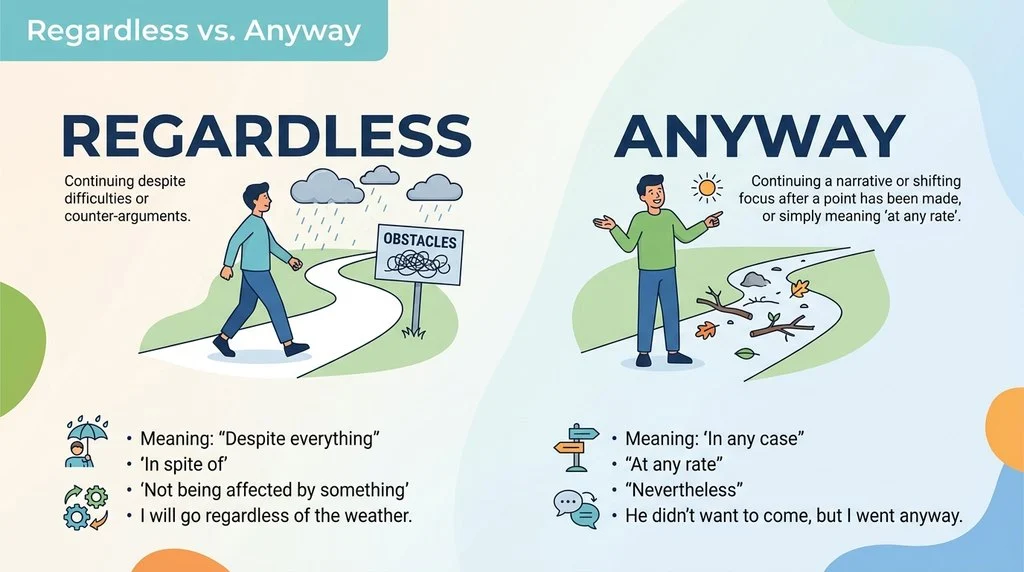
Regardless and anyway can sometimes communicate a similar idea, but they are not always interchangeable.
Regardless
Usually emphasizes that something happens despite a condition.
“It was raining, but we went regardless.”
Anyway
Can mean despite that, but it has several other conversational functions.
“It was raining, but we went anyway.”
Both sentences have essentially the same meaning here.
However, anyway can also be used to change the subject:
“Anyway, what were you saying?”
You cannot naturally replace it with regardless in that sentence.
Regardless vs. Despite
These two words are closely related.
Despite
Usually introduces the situation that could have prevented something.
“Despite the rain, we went outside.”
Regardless
Emphasizes that the situation does not change the outcome.
“It was raining, but we went outside regardless.”
A useful trick is to remember:
Despite X → something happens anyway.
Regardless → something happens no matter what.
Common Mistakes With Regardless
Although regardless is simple, people sometimes use it incorrectly.
Mistake 1: Saying “Irregardless” in Formal Writing
If you want standard, polished English, use regardless.
❌ “Irregardless of the weather…”
✅ “Regardless of the weather…”
Mistake 2: Using the Wrong Preposition
The common construction is:
regardless of + noun
For example:
✅ “Regardless of the cost, she bought it.”
Not:
❌ “Regardless from the cost…”
Mistake 3: Confusing Regardless With “It Doesn’t Matter”
They can be related, but regardless specifically shows that something continues or remains true despite another factor.
For example:
“I’ll go regardless.”
This means the speaker will go no matter what.
Funny and Relatable Examples of Regardless
Sometimes the word appears in situations that are almost too relatable.
- “I said I’d eat healthy, but pizza exists regardless of my plans.”
- “My alarm rang at 6 AM. I ignored it regardless of my responsibilities.”
- “I know I have enough clothes, but that sale exists regardless.”
- “The fridge is empty, but I opened it again regardless.”
- “I checked the weather three times and went outside regardless.”
- “I told myself I’d sleep early, then watched one more episode regardless.”
- “My phone battery is at 2%, but I’m scrolling regardless. 😂”
These examples show how regardless can add emphasis while keeping the sentence conversational.
When Should You Use Regardless?
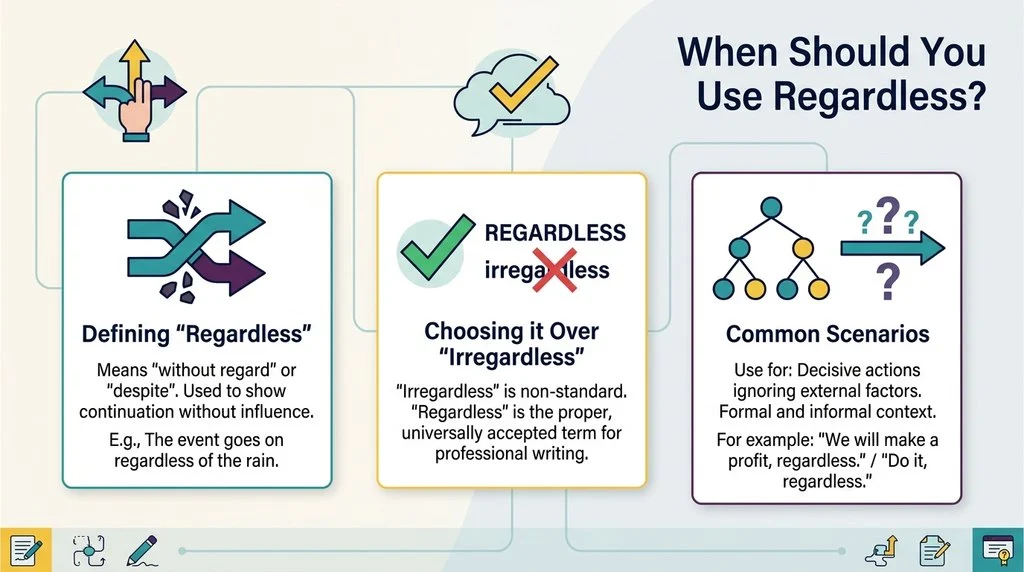
Use regardless when you want to communicate that something will happen or remain true even though another factor might normally affect it.
A quick checklist:
- Is there a situation that could change the outcome?
- Does that situation actually make no difference?
- Do you want to emphasize “no matter what”?
- If yes, regardless may be the right word.
Example
Situation:
You planned to go for a walk, but it started raining.
You could say:
“It started raining, but I went regardless.”
The rain is the condition, while going for the walk is the action that continues despite it.
Related Words and Expressions
If you’re learning regardless meaning, these related expressions are useful too.
| Word or PhraseBasic Meaning | |
|---|---|
| Regardless | Despite something |
| Anyway | Despite that / in any case |
| Despite | Without being prevented by something |
| Nevertheless | In spite of that |
| Nonetheless | Despite that |
| No matter what | Whatever happens |
| Either way | Whichever option happens |
| In any case | Whatever the circumstances |
These words are similar, but their grammar and tone can differ.
FAQs:
What does regardless mean in simple words?
Regardless means no matter what or despite something. It shows that a situation does not change the final action or result.
What does regardless mean in texting?
In texting, regardless usually means anyway, still, or no matter what. It is not normally a secret abbreviation.
Is regardless a slang word?
No. Regardless is a standard English word. People use it in texting and social media, but it is not specifically internet slang.
Is regardless the same as anyway?
They can have the same meaning in some sentences. For example, “I’m going regardless” and “I’m going anyway” both mean the speaker will go despite the circumstances.
Is irregardless correct?
Regardless is the standard form. “Irregardless” is commonly heard but is generally avoided in formal or polished writing.
Final Thoughts:
The easiest way to remember regardless meaning is “no matter what” or “despite that.” It tells someone that a particular situation does not change what happens next.
You can use regardless naturally in texts, social media posts, conversations, emails, and formal writing. When followed by a noun, the common structure is “regardless of.” If you want standard English, choose regardless rather than “irregardless.”
Now that you know how the word works, you can spot it easily in everyday conversations and use it confidently yourself. Share your favorite text abbreviation in the comments!

Hi, I’m Musaghumman, the mind behind EasyWordMeaning. I turn confusing words into easy meanings so anyone can learn, understand, and use English with confidence.