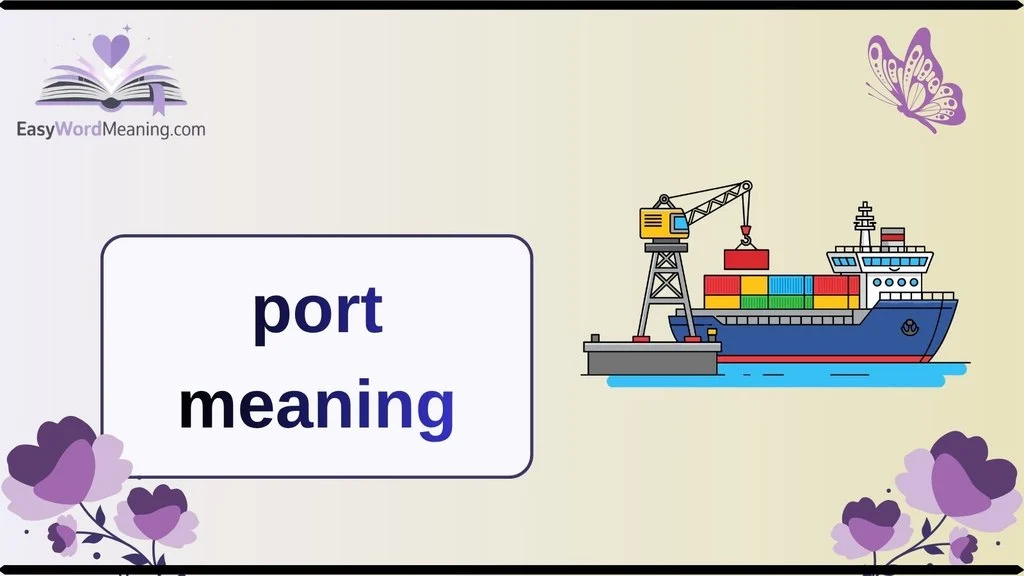
Seeing “port” in a text, DM, gaming chat, or online conversation can be confusing because it is not a typical texting abbreviation like “LOL,” “BRB,” or “IDK.” In most cases, port is a regular English word or technology term, and its exact meaning depends on the context.
For example, someone might say “port the game to PC,” “which port should I use?” or “we reached the port.” Those sentences use the same word in completely different ways.
What Does “Port” Mean in Text?

Port does not usually stand for a specific texting abbreviation. Instead, it is a normal word that has several meanings.
In online conversations, the most common meanings include:
- A connection point on a computer or device
- A network port used by software and internet services
- Moving software or a game from one platform to another
- Transferring a phone number to another carrier
- A harbor or place where ships arrive and leave
- The left side of a ship or aircraft
So, when someone writes “port” in a message, the surrounding conversation is important.
For example:
“Does this laptop have a USB-C port?”
Here, “port” means a physical connection point.
But:
“Are they going to port the game to PC?”
Here, “port” means adapting software so it works on another platform.
Is “Port” Slang or an Acronym?
Usually, no. “Port” is not commonly used as a texting acronym.
Unlike abbreviations such as “OMG” or “TBH,” the word port normally keeps its dictionary meaning. It has simply become especially common in conversations about computers, gaming, phones, networking, and other technology.
Some online slang websites describe “port” as a modern chat term, but it is more accurate to think of it as a standard word with specialized meanings, rather than a newly invented texting abbreviation.
Port Meaning in Different Contexts
Because “port” has multiple meanings, identifying the topic of the conversation is the easiest way to understand it.
1. Port Meaning in Technology
In technology, a port can mean a physical connection on a device.
Examples include:
- USB port
- HDMI port
- Ethernet port
- DisplayPort connection
- Audio port
For example:
“My laptop only has two USB ports.”
In this sentence, the person is talking about physical connectors that allow devices or cables to connect to a computer.
Cambridge Dictionary also defines a computer port as a part of a computer where equipment can be connected.
2. Port Meaning in Networking
In computer networking, port has a more technical meaning.
A network port is a logical communication endpoint that helps a computer direct network traffic to the correct application or service. Network ports are identified by numbers.
You might see messages such as:
“Which port is the server using?”
Or:
“The connection works, but the port is blocked.”
In these examples, “port” does not mean a USB or HDMI connector. It refers to a software/networking concept.
Some commonly encountered examples include:
- Port 80 — commonly associated with HTTP
- Port 443 — commonly associated with HTTPS
- Port 22 — commonly associated with SSH
The important point is that a network port and a physical computer port are different things, even though they share the same word.
3. Port Meaning in Gaming
Gamers frequently use port as a verb.
When someone says:
“They should port this game to PC.”
They mean they want the game to be adapted so it can run on another platform.
For example, a game originally released for one console might later receive a PC version. Gamers may call that new version a port.
You may see phrases such as:
- “PC port”
- “console port”
- “mobile port”
- “bad port”
- “game port”
- “port the game to another platform”
This meaning is particularly common in gaming forums, Discord-style discussions, social media posts, and gaming communities.
4. Port Meaning for Phone Numbers
“Port” can also appear in conversations about mobile phone services.
If someone says:
“I’m going to port my number.”
They generally mean they are moving their existing phone number from one carrier or service provider to another.
The number itself can remain the same even though the service provider changes.
For example:
“I switched carriers but ported my old number.”
Here, “port” means transfer the number to the new provider. Cambridge’s business dictionary also uses “port” as a verb for moving software or a phone number to another system.
Port Meaning in Social Media and Chat
On social media, “port” is usually understood from the topic being discussed.
It does not have one universal meaning across TikTok comments, Instagram DMs, gaming chats, Reddit-style forums, or text messages.
Consider these examples:
Tech conversation:
“Which port does the monitor use?”
Meaning: Which physical connection does the monitor use?
Gaming conversation:
“The game needs a better PC port.”
Meaning: The version adapted for PC needs improvement.
Networking conversation:
“Check whether port 443 is accessible.”
Meaning: Check the network communication endpoint.
Mobile conversation:
“I’m porting my number next week.”
Meaning: Moving the phone number to another carrier.
Travel conversation:
“The ship arrives at the port tomorrow.”
Meaning: A harbor or place where ships dock.
The word stays the same, but the subject tells you which meaning applies.
How to Use “Port” Correctly in Texts or Chat
If you’re using “port” yourself, don’t treat it like a shortcut such as “BTW” or “IDK.” Instead, use it naturally according to the meaning you intend.
When Talking About Devices
Use “port” when referring to a connection point:
“Do you know which port this cable uses?”
“My laptop doesn’t have that port.”
When Talking About Games or Software
Use “port” when discussing software adapted for another platform:
“The developers finally ported the game to PC.”
“That console port has some performance issues.”
When Talking About Phone Services
Use “port” when discussing transferring a phone number:
“I’m planning to port my number to another carrier.”
When Talking About Networking
Use “port” when discussing a network service or connection:
“The server is listening on a different port.”
When Talking About Travel
Use “port” to refer to a harbor:
“The cruise ship will stop at another port.”
Examples of “Port” in Conversations
Here are realistic examples showing how the meaning changes depending on the conversation.
Example 1: Tech Chat
Alex: Does this laptop support HDMI?
Sam: Yeah, there’s an HDMI port on the side.
Meaning: “Port” means a physical connection.
Example 2: Gaming Chat
Alex: Is that game coming to PC?
Sam: Hopefully. I heard they’re working on a PC port.
Meaning: “Port” means a version adapted for PC.
Example 3: Networking Chat
Alex: Why can’t the app connect to the server?
Sam: Maybe the required port is blocked.
Meaning: “Port” refers to a network communication endpoint.
Example 4: Mobile Service Chat
Alex: Did you get a new number?
Sam: No, I just ported my old number to a different carrier.
Meaning: “Ported” means transferred the number to another provider.
Example 5: Travel Conversation
Alex: Where is the ship stopping?
Sam: It should reach the next port tomorrow morning.
Meaning: “Port” means a harbor or harbor city.
Common Mistakes and Misunderstandings
Because “port” has several meanings, it is easy to misunderstand it.
Mistake 1: Assuming It Is a Texting Acronym
One of the biggest mistakes is assuming every unusual-looking word online must be slang.
Port is generally not a standard texting acronym.
If someone sends “port,” don’t automatically try to expand it into a phrase made from four letters.
Instead, look at what you were discussing.
Mistake 2: Confusing a Physical Port With a Network Port
These two meanings are related but different.
A physical port is something you can plug a cable into.
A network port is a logical endpoint used by network communication.
So if someone says:
“Port 443 is open.”
They aren’t talking about a hole on the side of a laptop.
Mistake 3: Confusing “Port” With “Post”
Typing quickly can sometimes cause confusion between similar-looking words.
Compare:
- Post = publish or upload something
- Port = a connection point, transfer/adaptation, harbor, or other context-specific meaning
If you see “port” in a message, don’t automatically assume the person meant “post.”
Mistake 4: Ignoring the Conversation Topic
Context is especially important with words that have multiple definitions.
If you’re talking about gaming, “port” probably relates to software.
If you’re talking about cables, it probably refers to a physical connector.
If you’re discussing ships, it probably means a harbor.
The surrounding words usually reveal the intended meaning.
“Port” vs. Similar Terms
Understanding a few related words can make the meaning easier to recognize.
Port vs. Connector
A connector generally refers to the physical component at the end of a cable or wire, while a port is commonly the place on a device where that connection is made.
For everyday tech conversations, people may use these terms loosely, but they aren’t always technically identical.
Port vs. Plug
A plug is typically the part that gets inserted into a port.
For example:
“Plug the cable into the USB port.”
The plug goes into the port.
Port vs. Protocol
In networking, a protocol is a set of rules for communication, while a port helps identify where network traffic should be delivered.
They’re connected concepts, but they aren’t interchangeable.
Port vs. Platform
In gaming, a platform might mean PC, PlayStation, Xbox, or another system.
A port is software adapted to work on that platform.
For example:
“The game is available on several platforms.”
“The PC port was released later.”
Related Slangs and Abbreviations
If you’re researching port meaning in text, you may also encounter other technology and internet terms.
LOL
LOL means “laughing out loud.” It is commonly used when something is funny.
BRB
BRB means “be right back.”
BTW
BTW means “by the way.”
DM
DM means “direct message,” especially on social media platforms.
IRL
IRL means “in real life.”
AFK
AFK means “away from keyboard” and is particularly common in gaming and online communities.
Unlike these abbreviations, port is normally a complete word rather than an acronym.
How to Tell Which “Port” Meaning Someone Intended
When you’re unsure what someone means, use this quick process:
- Look at the topic.
Are you discussing gaming, computers, travel, or phones? - Check the words around “port.”
Phrases such as “PC port,” “USB port,” or “network port” provide strong clues. - Look at whether it is a noun or verb.
“The port is blocked” and “port the game” use the word differently. - Ask for clarification if necessary.
A simple “Do you mean the network port or the USB port?” can clear things up immediately. - Don’t assume it is slang.
Many words appearing in online conversations are ordinary words used in specialized contexts.
Frequently Asked Questions:
What does “port” mean in texting?
Port usually isn’t a texting abbreviation. Its meaning depends on the conversation. It can refer to a device connection, network endpoint, software adaptation, phone-number transfer, harbor, or another standard meaning.
Is “port” a slang word?
Not usually. Port is primarily a standard English word, although it is widely used as technical jargon in computing, gaming, networking, and telecommunications.
What does “port” mean in gaming?
In gaming, port usually means adapting a game so it can run on another platform. A “PC port,” for example, is a version of a game adapted for PC.
What does “port” mean in networking?
In networking, a port is a logical communication endpoint identified by a number. It helps network traffic reach the appropriate application or service on a device.
What does “port” mean for a phone number?
To port a phone number means to transfer an existing number from one carrier or service provider to another while generally keeping the number.
Does “port” mean harbor?
Yes. In travel or maritime conversations, a port can mean a harbor or a town/city associated with a harbor where ships load, unload, or stop.
Is “port” the same as “USB”?
No. USB refers to a technology/connection standard, while a USB port is the connection point on a device that accepts a compatible USB connector.
Final Thoughts:
The simplest answer to “port meaning” is: it depends on context. Unlike many popular chat abbreviations, “port” is generally not an acronym created specifically for texting.
In technology conversations, it may mean a physical connection or a network endpoint. In gaming, it commonly means software adapted for another platform. In mobile-service conversations, it can mean transferring a phone number. In travel conversations, it can refer to a harbor.
So the next time you see “port” in a text or online chat, don’t immediately assume it’s slang. Read the surrounding conversation first—the context will usually make the intended meaning obvious.
Found another internet word you’re unsure about? Share your favorite text abbreviation or confusing chat term in the comments!

Hi, I’m Musaghumman, the mind behind EasyWordMeaning. I turn confusing words into easy meanings so anyone can learn, understand, and use English with confidence.