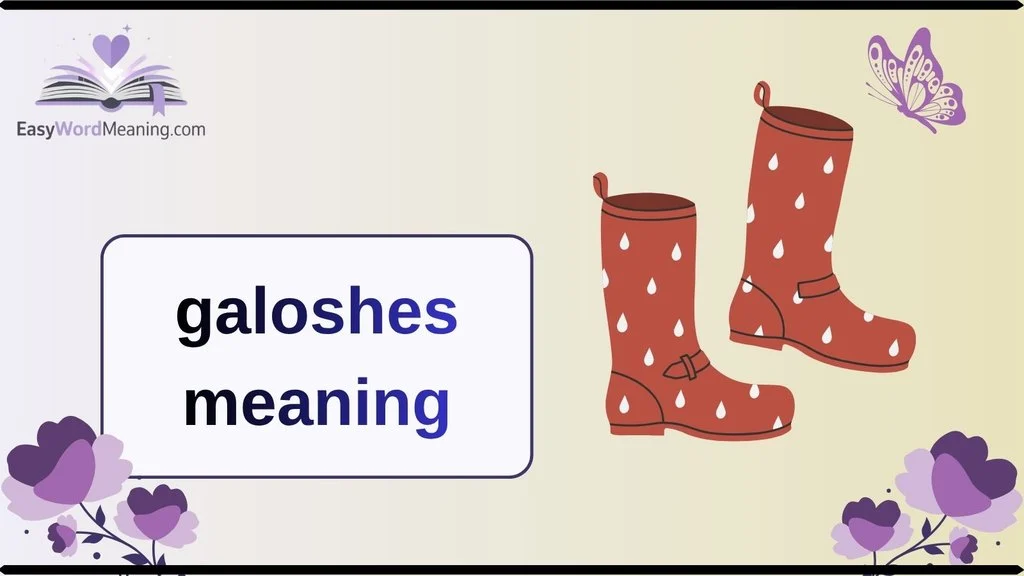
If you came across the word “galoshes” in a conversation, book, social media post, or online article, you might wonder what it means. Unlike popular texting abbreviations such as “LOL” or “BRB,” galoshes is not internet slang.
It is a regular English word that refers to protective footwear worn over shoes, especially in wet, muddy, or snowy weather.
Understanding the galoshes meaning can help you recognize the word when it appears in older books, weather-related conversations, fashion discussions, or casual jokes online. The word may sound unusual today, but it has a long history in English.
What Does “Galoshes” Mean?
Galoshes are waterproof or water-resistant coverings worn over ordinary shoes to protect them from rain, mud, snow, or wet ground.
In simple terms:
Galoshes = protective footwear worn over shoes to keep your feet and shoes dry.
For example, if someone says:
- “Put on your galoshes before you go outside.”
- “It’s raining heavily, so I’m wearing my galoshes.”
- “My old galoshes kept my shoes clean in the mud.”
They are talking about protective footwear for wet conditions.
The singular form is galosh, while galoshes is the plural form.
Galosh vs. Galoshes
The distinction is straightforward:
- Galosh — one protective shoe covering
- Galoshes — more than one, or the footwear as a pair
You will usually see galoshes used in everyday conversation because people normally wear them as a pair.
Galoshes Meaning in Simple English
If you want the easiest possible definition, think of galoshes as waterproof overshoes.
Imagine you are wearing your favorite sneakers and suddenly it starts raining. Instead of replacing your shoes or walking through puddles in them, you could wear waterproof coverings over them.
That is essentially what galoshes are designed to do.
They are particularly associated with:
- Rainy weather
- Muddy roads
- Snow
- Wet outdoor conditions
- Protecting regular shoes
- Keeping feet and footwear cleaner
The exact design can vary. Some galoshes look like rubber overshoes, while others resemble short boots.
Where Does the Word “Galoshes” Come From?
The word galosh has an interesting history.
English borrowed the word from French galoche, which referred to a type of shoe or wooden-soled footwear. The word has also been connected historically with forms found in other European languages.
Over time, the meaning developed into the modern idea of protective footwear worn over another shoe.
This is one reason galoshes can sound old-fashioned to modern English speakers. You may encounter the word more frequently in older literature, historical writing, or descriptions of traditional clothing than in everyday texting.
Are Galoshes Slang?
No, “galoshes” is not normally slang or a texting abbreviation.
This is an important point because many people search for unfamiliar words online assuming they might be slang.
Unlike:
- LOL
- OMG
- BRB
- IDK
- TBH
galoshes is a standard English noun.
It can certainly appear in casual messages, social media posts, jokes, and memes, but its basic dictionary meaning remains the same.
For example:
“I forgot my galoshes and now my shoes are soaked.”
That is simply a normal use of the word.
How to Use “Galoshes” in Texts or Chat
Although galoshes are not specifically related to internet culture, you can easily use the word in texts and online conversations.
Talking About Rain
Rain is probably the easiest context.
Example:
“It looks like it’s going to rain all afternoon. Better grab your galoshes!”
Here, the speaker is telling someone to wear waterproof footwear.
Talking About Mud
Galoshes can also be useful when discussing muddy conditions.
Example:
“The backyard is basically a swamp after yesterday’s storm. Time for the galoshes.”
This could be completely serious or slightly humorous depending on the conversation.
Talking About Old-Fashioned Fashion
Because the word can sound somewhat old-fashioned, people sometimes use it humorously.
Example:
“Grab your umbrella, coat, and galoshes. We’re officially ready for a Victorian-era adventure.”
The word adds a playful or vintage feel to the message.
Using Galoshes as a Joke
You might even see someone exaggerating the word for comedic effect.
Example:
“The puddle is enormous. I need galoshes, a canoe, and possibly a lifeguard.”
Here, the humor comes from exaggerating how wet the weather is.
Examples of “Galoshes” in Conversations
Here are several realistic examples showing how the word might appear in modern communication.
Example 1: Friends Talking About Rain
Alex: “Are you still going to the park?”
Sam: “Maybe. It’s pouring outside.”
Alex: “Bring your galoshes!”
The word is used playfully to mean waterproof footwear.
Example 2: Family Conversation
Parent: “Don’t forget your coat and galoshes.”
Child: “Do I really need them?”
Parent: “Yes. Look at the rain!”
This is a straightforward everyday use.
Example 3: Social Media Caption
“Rainy day essentials: coffee, an umbrella, and galoshes.”
The word gives the caption a slightly vintage or humorous style.
Example 4: Online Joke
“Me: I love rainy weather.
Also me five minutes later: Where are my galoshes?”
This type of exaggerated weather joke works well because many people dislike getting their shoes wet.
Example 5: Muddy Hiking Trail
Friend 1: “How bad is the trail?”
Friend 2: “Very muddy. Wear something waterproof.”
Friend 1: “So… galoshes?”
Friend 2: “Absolutely.”
Galoshes vs. Boots
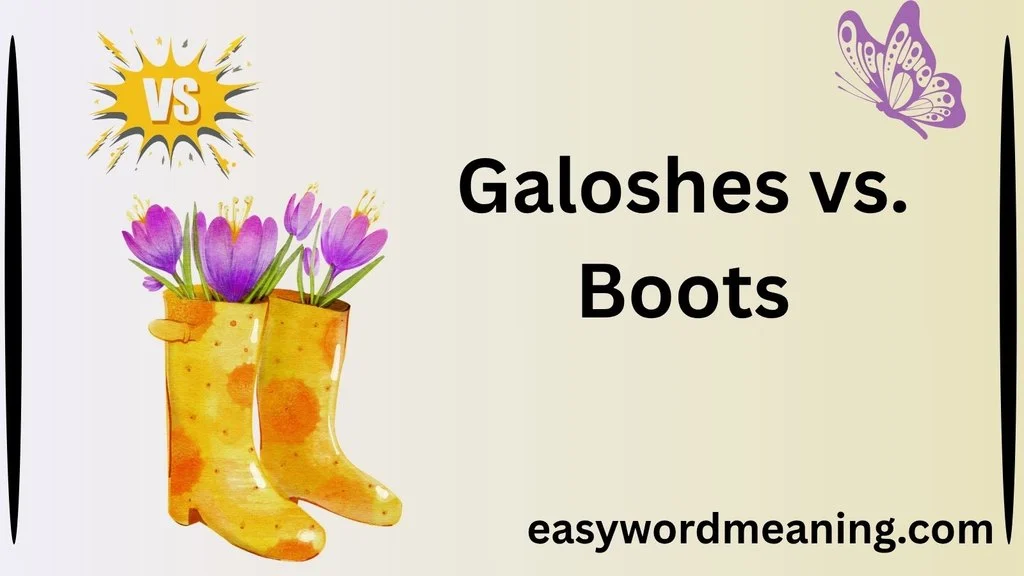
One common misunderstanding is assuming that galoshes and boots are exactly the same thing.
They can be similar, but the terms aren’t always interchangeable.
Boots are a type of footwear designed to be worn directly on your feet. They come in many styles, including hiking boots, rain boots, winter boots, and work boots.
Galoshes, on the other hand, traditionally refer to protective footwear or coverings worn over another pair of shoes.
For example:
- You wear sneakers → put galoshes over them.
- You wear rain boots → the boots themselves already provide weather protection.
The distinction can vary depending on region and historical usage, so the terms aren’t always used identically.
Galoshes vs. Overshoes
Overshoes is probably the closest modern synonym for galoshes.
Both can describe protective coverings worn over regular footwear.
For example:
“I put my overshoes on because the pavement was covered in slush.”
and
“I put my galoshes on because the pavement was covered in slush.”
Both sentences communicate essentially the same idea.
However, galoshes has a more traditional or old-fashioned sound, while overshoes is more immediately understandable to many modern English speakers.
Galoshes vs. Rain Boots
There is also a difference between galoshes and rain boots.
Rain boots are normally complete boots worn directly on the feet. They are specifically designed to keep feet dry.
Galoshes are traditionally protective coverings worn over shoes.
That said, dictionary definitions and regional usage can overlap, and some people use “galoshes” more broadly for waterproof footwear.
So if someone says:
“I need my galoshes; it’s raining.”
The safest interpretation is simply waterproof footwear for rainy conditions.
Common Mistakes or Misunderstandings
Because “galoshes” is less common than words like “boots” or “shoes,” it can cause some confusion.
Mistake 1: Thinking It Is Internet Slang
The biggest misconception is assuming that galoshes is an abbreviation or social media expression.
It isn’t.
Galoshes is a standard English word.
Mistake 2: Thinking It Means Any Shoe
Galoshes aren’t simply ordinary shoes.
The traditional meaning specifically involves protective footwear or coverings, especially for wet conditions.
Mistake 3: Confusing It With “Galosh”
Remember that galosh is singular and galoshes is plural.
For example:
- “I found one galosh.”
- “I found my galoshes.”
Because footwear is normally worn as a pair, the plural form is much more common.
Mistake 4: Assuming the Word Is Completely Outdated
Although “galoshes” can sound old-fashioned, it hasn’t disappeared from English.
You may still encounter it in conversations, dictionaries, literature, weather discussions, product descriptions, and humorous online posts.
Why Does “Galoshes” Sound Funny or Old-Fashioned?
Language changes over time.
Words that were once common can become less frequent as people adopt simpler or more modern alternatives. Today, many speakers are more likely to say rain boots, waterproof shoes, or overshoes.
As a result, “galoshes” can have a charmingly old-fashioned sound.
That makes it useful for humor.
Someone might say:
“Put on your galoshes, young traveler!”
instead of simply saying:
“Put on your boots.”
The first sentence sounds much more dramatic.
Related Words and Terms
If you’re learning the meaning of galoshes, these related words are useful to know:
Overshoes
Protective footwear worn over regular shoes.
Rain Boots
Water-resistant or waterproof boots designed for wet weather.
Waterproof Shoes
Shoes made with materials or construction intended to prevent water from reaching the feet.
Boots
Footwear that generally extends above the foot and can serve many different purposes.
Rubbers
In some varieties of English, especially older or regional usage, “rubbers” can refer to rubber overshoes or galoshes.
Because terminology varies by country and generation, context matters.
Is “Galoshes” Still Used Today?
Yes, but it isn’t one of the most common everyday footwear words.
Modern speakers often choose terms such as rain boots, waterproof boots, or overshoes instead.
Still, “galoshes” remains recognizable and appears in:
- Books and literature
- Historical writing
- Weather-related conversations
- Fashion discussions
- Social media captions
- Humor and jokes
- Online discussions
- Product descriptions
Its relative rarity can actually make it stand out.
Fun Ways to Use “Galoshes”
If you’re looking for a playful word for a rainy-day conversation, galoshes can be surprisingly useful.
Try these lighthearted examples:
- “The rain is wild today. Deploy the galoshes!”
- “My shoes have officially requested galoshes.”
- “Rain forecast: 100%. Galoshes: absolutely necessary.”
- “I’m ready for the storm—umbrella in one hand, galoshes on my feet.”
- “These puddles are demanding professional-grade galoshes.”
These examples aren’t slang definitions. They’re simply modern, humorous ways to use an older word in casual conversation.
FAQs:
What does galoshes mean?
Galoshes means protective waterproof or water-resistant footwear, traditionally worn over regular shoes to protect them from rain, mud, or snow.
Is galoshes a slang word?
No. Galoshes is a standard English word, not a texting abbreviation or internet slang term.
What is the singular of galoshes?
The singular is galosh.
For example, one piece is a galosh, while a pair is called galoshes.
Are galoshes the same as rain boots?
Not always. Traditionally, galoshes are protective coverings worn over shoes, while rain boots are generally worn directly on the feet. However, everyday usage can overlap.
What is another word for galoshes?
Overshoes is one of the closest alternatives. Depending on the context, people may also say waterproof footwear or rain boots.
Why don’t I hear the word galoshes very often?
The word has become less common in everyday modern speech. Many people now use terms such as rain boots, waterproof shoes, or overshoes instead.
Can I use galoshes in a text message?
Absolutely. For example:
“It’s raining like crazy—better bring your galoshes!”
It sounds casual, although it may also give the message a playful or old-fashioned tone.
Final Takeaway:
The galoshes meaning is simple: galoshes are protective footwear, traditionally worn over shoes to keep them safe from rain, mud, snow, and other wet conditions.
The word isn’t internet slang or a texting abbreviation. It is an established English word with a long history, and although it may sound somewhat old-fashioned today, it can still appear in everyday conversations, books, social media, and humorous messages.
So, the next time someone tells you to grab your galoshes, they aren’t sending you a secret abbreviation—they’re telling you to prepare for wet weather.
Now that you know what galoshes means, share your favorite unusual English word or text abbreviation in the comments!

Hi, I’m Musaghumman, the mind behind EasyWordMeaning. I turn confusing words into easy meanings so anyone can learn, understand, and use English with confidence.