If you’ve come across the word “forsake” in a book, movie, song, Bible verse, social media post, or everyday conversation, you may wonder what it actually means. The word can sound old-fashioned or formal, but its meaning is fairly simple once you see it in context.
Forsake generally means to leave someone or something behind, abandon it, or give it up completely. It can describe leaving a person, walking away from a responsibility, abandoning a habit, or giving up an idea or belief.
This guide explains the forsake meaning in simple language, shows how to use it correctly, and provides plenty of real-world examples. It also covers its origin, synonyms, common mistakes, and related words.
What Does “Forsake” Mean?
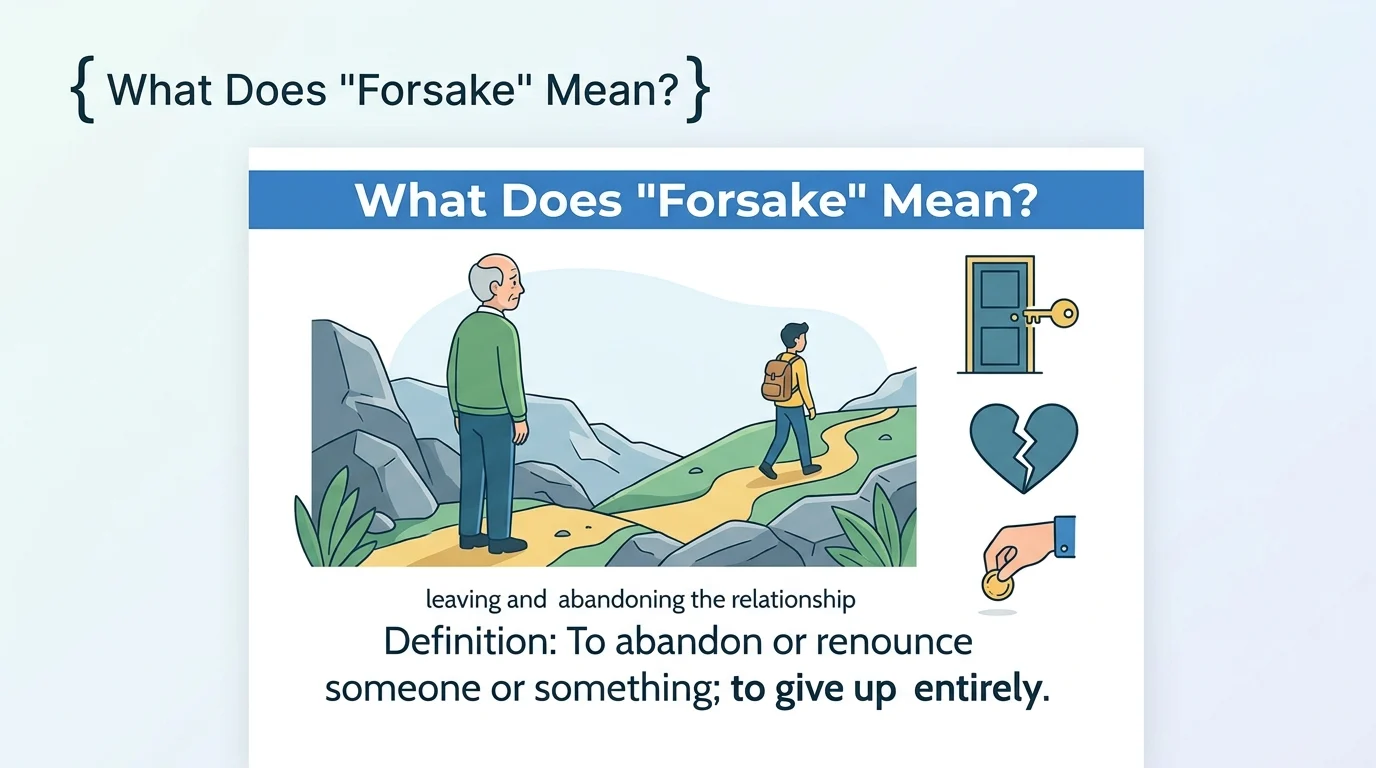
The word forsake means to abandon, leave behind, or give up someone or something.
In simple terms:
Forsake = to leave or abandon completely.
The word often carries a stronger emotional meaning than simply saying “leave.”
For example:
- She decided to forsake her old lifestyle.
- He promised never to forsake his family.
- They forsook their original plan.
- The traveler was forsaken by his companions.
When someone forsakes another person, it can suggest that they have deliberately walked away from them or stopped supporting them.
Simple Definition of Forsake
Here are a few easy ways to understand it:
- Forsake someone: Leave or abandon them.
- Forsake something: Give it up or stop following it.
- Forsake a belief: Stop believing in or following that belief.
- Forsake a habit: Completely give up that habit.
So, if someone says, “I will never forsake you,” they mean:
“I will never abandon or leave you.”
Forsake Meaning in Simple English
If you want the easiest possible explanation, think of forsake as:
Leave + abandon + give up
However, the exact meaning depends on the sentence.
For example:
“He forsook his friends.”
This means:
“He abandoned or left his friends.”
Another example:
“She forsook her old ways.”
This means:
“She gave up her old ways and chose a different lifestyle.”
The word can therefore describe both people and things.
Forsake Meaning in Texting and Online Conversations
Although forsake isn’t a typical texting abbreviation like LOL, BTW, or IDK, people may still use the word in online conversations.
Someone might use it when writing something dramatic, humorous, poetic, or emotional.
For example:
Friend: Are you really quitting the game?
You: Yes. I have forsaken my gaming career. 😂
Here, “forsaken” is being used humorously to mean given up or abandoned.
Another example:
“I have forsaken my late-night snacks.”
This means:
“I have given up my late-night snacks.”
Because “forsake” sounds somewhat formal or dramatic, using it casually can make a sentence sound playful.
What Is the Origin of Forsake?
Forsake is an old English word with Germanic roots. It has been used in English for centuries and is related to older words carrying the idea of abandoning or leaving behind.
Its historical use helps explain why it sometimes sounds more formal or literary than everyday words such as “leave” or “quit.”
The word has also remained especially recognizable because it appears frequently in religious texts, classic literature, poetry, and traditional expressions.
For example, phrases involving “forsake” may refer to abandoning a person, a duty, a path, or a belief.
Today, the word is still understood, although everyday speakers are often more likely to use simpler alternatives such as:
- Leave
- Abandon
- Give up
- Walk away from
- Quit
How to Use “Forsake” in a Sentence
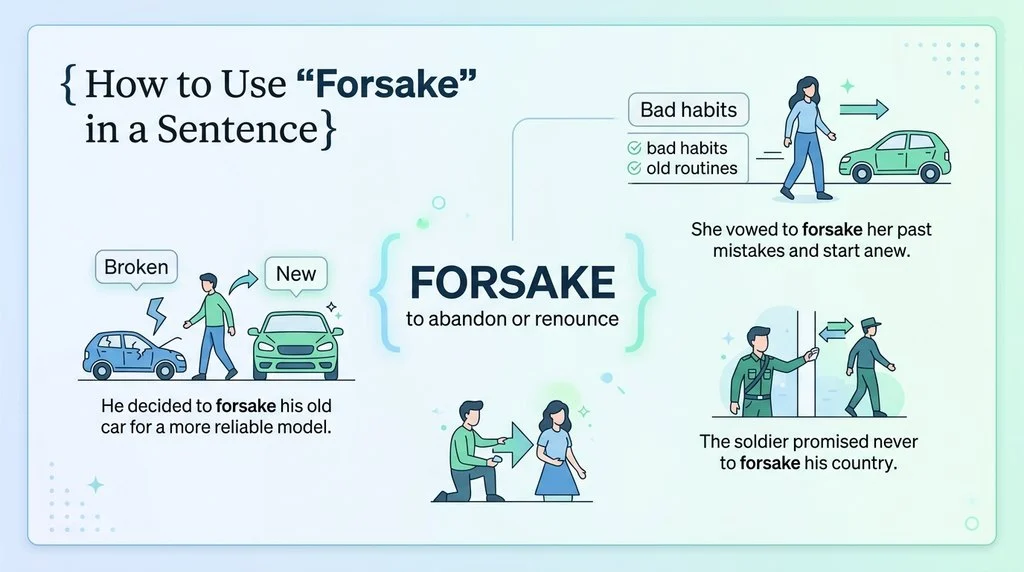
Using forsake correctly is easier when you remember that it is usually followed by the person, thing, belief, habit, or principle being abandoned.
Basic Sentence Pattern
Subject + forsake + object
Examples:
- He forsook his responsibilities.
- She refused to forsake her family.
- They forsook their original plan.
- I will never forsake my principles.
Notice that “forsake” can be used with both people and abstract ideas.
Using Forsake in Everyday English
Although it sounds formal, you can use it creatively in casual writing.
For example:
- I have forsaken my diet for pizza tonight. 🍕
- She forsook her alarm clock and slept until noon.
- He has forsaken coffee and switched to tea.
- We forsook our original plans because it started raining.
These sentences are grammatically understandable, but everyday speakers might use “gave up,” “left,” or “abandoned” instead.
Forsake Verb Forms
One important thing to remember is that forsake is an irregular verb.
Its main forms are:
| Form | Word |
|---|---|
| Base form | forsake |
| Present | forsake / forsakes |
| Past tense | forsook |
| Past participle | forsaken |
| -ing form | forsaking |
Examples
Present:
I will never forsake my responsibilities.
Past:
He forsook his former lifestyle.
Past participle:
She had forsaken her old habits.
-ing form:
Forsaking your responsibilities can create problems.
A common mistake is writing “forsaked.” That is incorrect.
The correct past tense is “forsook,” while the past participle is “forsaken.”
Forsake vs. Forsook vs. Forsaken
These three forms can be confusing.
Forsake
Use forsake as the base form.
I would never forsake my family.
Forsook
Use forsook as the simple past tense.
He forsook his old career.
Forsaken
Use forsaken as the past participle, often with helping verbs such as “has,” “have,” “had,” or “was.”
She had forsaken her previous beliefs.
The village was completely forsaken.
A quick way to remember them is:
Forsake → Forsook → Forsaken
Examples of Forsake in Conversations

Here are some realistic examples showing how the word might appear in conversation.
Example 1: Giving Up a Habit
Alex: Are you still drinking soda every day?
Sam: No, I’ve forsaken soda for good.
Meaning: Sam has completely given up soda.
Example 2: Leaving Someone
Mia: Did your friends leave when things became difficult?
Liam: No, they never forsook me.
Meaning: His friends never abandoned him.
Example 3: Giving Up a Plan
Emma: What happened to your travel plans?
Noah: We forsook the original plan and decided to stay home.
Meaning: They abandoned their original plan.
Example 4: Humorous Use
Friend: Are you still going to wake up at 5 a.m.?
Me: Absolutely not. I have forsaken that ridiculous idea. 😂
Here, forsaken adds a dramatic and humorous tone.
Example 5: Online Post
“I have forsaken productivity and chosen to watch one more episode.”
This is a playful way to say:
“I gave up being productive and decided to watch another episode.”
Common Synonyms for Forsake
Several words can have a similar meaning to forsake, but the best choice depends on the context.
1. Abandon
Abandon means to leave someone or something behind, often permanently.
They abandoned the project.
2. Leave
Leave is the simplest and most common alternative.
She left her old job.
3. Give Up
Give up is commonly used when someone stops doing something or abandons an effort.
He gave up smoking.
4. Desert
Desert can mean abandoning someone or something, especially when support or loyalty is expected.
The soldiers deserted their post.
5. Renounce
Renounce often means formally rejecting or giving up something, such as a belief, claim, or position.
He renounced his former beliefs.
6. Quit
Quit is informal and common in everyday English.
She quit her job.
Forsake vs. Abandon: What’s the Difference?
Forsake and abandon are close in meaning, but they can feel slightly different.
Abandon is much more common in modern everyday English.
Forsake often has a more emotional, formal, literary, or dramatic tone.
Compare:
He abandoned his family.
and
He forsook his family.
Both indicate leaving or abandoning his family, but forsook sounds more literary or formal.
In ordinary conversation, “abandoned” or “left” will usually sound more natural.
Is “Forsake” a Positive or Negative Word?
The word itself is generally context-dependent, but it often describes something negative or emotionally serious because it involves abandonment or giving something up.
For example:
She forsook her harmful habits.
Here, forsaking harmful habits is presented positively.
But:
He forsook his family.
This has a negative implication because abandoning one’s family is generally presented as harmful or painful.
Therefore, forsake doesn’t automatically mean something bad. The surrounding sentence determines the tone.
Common Mistakes When Using Forsake
Mistake 1: Saying “Forsaked”
One of the most common errors is using forsaked as the past tense.
❌ He forsaked his old life.
✅ He forsook his old life.
Mistake 2: Confusing Forsake With Forget
Forsake does not simply mean “forget.”
If someone forgets your birthday, they may have failed to remember it.
If someone forsakes you, they have abandoned or left you.
These meanings are very different.
Mistake 3: Using It Everywhere
“Forsake” is grammatically useful, but it can sound formal.
Instead of:
I forsook my sandwich because I wasn’t hungry.
Most people would naturally say:
I left my sandwich because I wasn’t hungry.
Use forsake when you want a stronger, more formal, literary, or dramatic tone.
Mistake 4: Confusing “Forsaken” With “Forsake”
Remember:
- Forsake = base verb
- Forsook = past tense
- Forsaken = past participle/adjective
For example:
Don’t forsake your goals.
He forsook his old ambitions.
The place looked forsaken.
What Does “Forsaken” Mean?
Forsaken is the past participle of forsake, but it can also work as an adjective.
When used as an adjective, forsaken often means abandoned, deserted, or completely left behind.
For example:
The old house looked forsaken.
This means the house appeared abandoned and neglected.
Another example:
He felt forsaken by everyone.
This means he felt abandoned or left without support.
The word forsaken is especially common in literary and religious language.
Is Forsake Still Used Today?
Yes. Forsake is still a valid and recognizable English word.
However, it is not among the most common words used in casual everyday conversation.
You are more likely to encounter it in:
- Books
- Poetry
- Religious texts
- Songs
- Movies and dramatic dialogue
- Formal writing
- Inspirational quotes
- Historical writing
- Online posts using dramatic or humorous language
Modern speakers generally choose leave, abandon, quit, or give up in casual conversation.
That doesn’t make “forsake” outdated or incorrect. It simply gives the word a more formal or literary flavor.
Fun and Relatable Examples of “Forsake”
Want to use forsake in a funny way? Try these:
- I have forsaken my diet for a slice of cake. 🎂
- My bed has forsaken me by refusing to let me get comfortable.
- I forsook productivity the moment I opened social media.
- She has forsaken coffee and embraced tea.
- We have forsaken our original plans in favor of staying home.
- I shall never forsake pizza. 🍕
- He forsook his alarm and chose five more hours of sleep.
- They forsook the gym for a movie marathon.
Using a formal word in a silly situation can make the sentence intentionally dramatic.
Related Words and Expressions
If you’re learning vocabulary around forsake, these words are worth knowing:
- Abandon — leave behind
- Desert — leave or abandon
- Renounce — formally give up
- Reject — refuse to accept
- Quit — stop doing something
- Relinquish — voluntarily give something up
- Discard — get rid of something
- Withdraw — move away or stop participating
- Forsaken — abandoned or deserted
- Forsook — past tense of forsake
These words overlap with “forsake,” but they are not always interchangeable.
FAQs:
What does forsake mean in simple words?
Forsake means to leave, abandon, or give up someone or something, often completely.
What is the past tense of forsake?
The past tense of forsake is forsook.
Example:
He forsook his old lifestyle.
What is the past participle of forsake?
The past participle is forsaken.
Example:
She had forsaken her old habits.
Is forsake the same as abandon?
They have very similar meanings. However, forsake often sounds more formal, literary, or emotional, while abandon is more common in everyday English.
What is a simple synonym for forsake?
Depending on the context, simple synonyms include leave, abandon, give up, quit, or walk away from.
Is forsake commonly used in texting?
Not particularly. Forsake is not a typical texting abbreviation. However, people can use the word in texts, social media posts, jokes, and dramatic messages when they want to express abandonment or giving something up.
Final Thoughts:
The simplest way to remember the forsake meaning is “to abandon, leave behind, or give up.” It can refer to people, habits, plans, beliefs, responsibilities, or other things.
Remember the three important forms: forsake → forsook → forsaken. While the word sounds more formal than “leave” or “give up,” it remains useful and perfectly correct in modern English.
Now that you know what forsake means, you’ll be able to recognize it more easily in books, conversations, online posts, and formal writing. Share your favorite interesting English word or text abbreviation in the comments!

Hi, I’m Musaghumman, the mind behind EasyWordMeaning. I turn confusing words into easy meanings so anyone can learn, understand, and use English with confidence.