Understanding the elephant in the room meaning matters more than ever in today’s chat-first world.
From WhatsApp to X, Reddit to Slack, this phrase pops up when something obvious is being ignored.
If you’ve seen it in texts or comments and wondered what it really implies, you’re in the right place.
This guide is Updated for 2026, easy to read, and built to help you use the phrase naturally and confidently. 😊
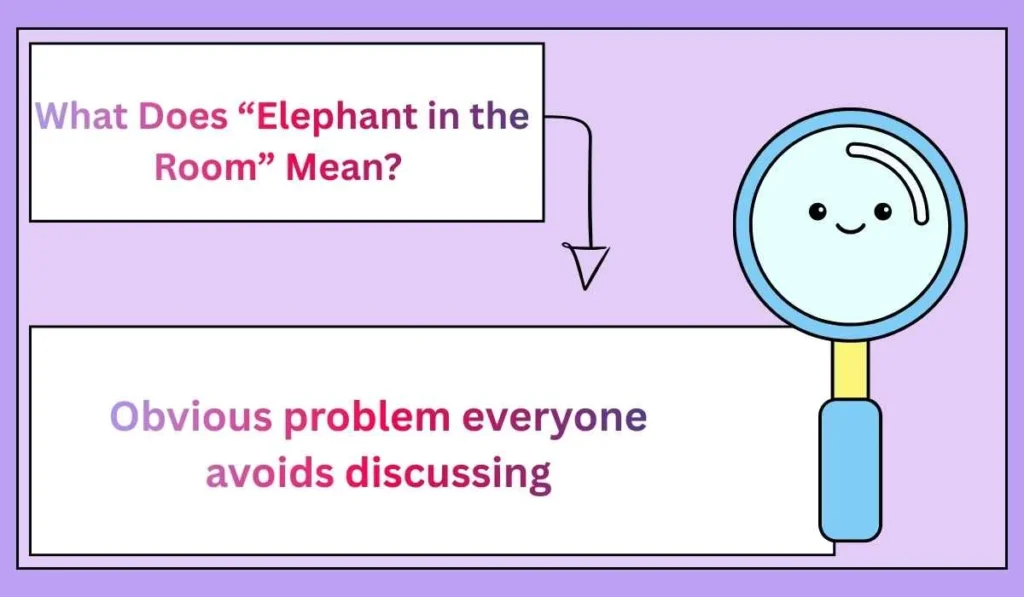
What Does “Elephant in the Room” Mean? 🐘
Definition & Origin
Elephant in the room meaning:
It refers to a big, obvious problem, truth, or topic that everyone notices—but no one wants to talk about. Imagine a literal elephant standing in a small room. You can’t miss it, yet people pretend it’s not there. That’s the vibe.
Where did it come from?
- The phrase dates back to 19th-century English literature
- It became popular because it paints a clear mental image
- Over time, it moved from books → conversations → modern texting and online chats
Today, it’s not slang in the traditional sense—but it’s internet-native, widely used in memes, tweets, captions, and comment sections.
💡 Quick takeaway:
If something feels awkwardly obvious and ignored, that’s the elephant in the room.
How to Use “Elephant in the Room” in Texts or Chat 💬
You’ll often see this phrase when people want to:
- Call out awkward silence
- Point to ignored drama
- Start a serious talk without sounding aggressive
Common chat situations:
- Group chats 👥
- Office Slack messages 💼
- Social media comments 📱
- Reddit or forum discussions 🧵
Simple text-style uses:
- “Can we talk about the elephant in the room? 😅”
- “Not to be rude, but that’s the elephant in the room.”
- “Everyone’s joking, but the elephant in the room is still there.”
📝 Pro tip:
Use it when you want to sound honest but calm, not rude or attacking.
Examples of “Elephant in the Room” in Conversations 🗨️
Casual texting
“Before we plan the trip, let’s address the elephant in the room—we’re broke 😂”
Work or study chat
“The deadline we missed is kind of the elephant in the room here.”
Social media / online comments
“All these reviews but no one’s mentioning the bug… that’s the elephant in the room 🐘”
Funny / relatable
“We’re all pretending nothing happened, but that awkward silence is the elephant in the room 😭”
These examples show how flexible the phrase is—it works in serious, funny, and sarcastic tones.
Common Mistakes or Misunderstandings ❌
Even though it’s simple, people still misuse it. Here’s what to avoid:
❌ Using it for small issues
Wrong:
“My coffee is cold, that’s the elephant in the room.”
✅ Correct:
Use it only for big or obvious issues, not minor annoyances.
❌ Thinking it means “secret”
It’s not a hidden secret.
It’s something everyone already knows, but avoids discussing.
❌ Overusing it
If you say it in every conversation, it loses impact. Save it for moments that really matter.
Related Slangs or Abbreviations 🔗
If you like phrases similar to elephant in the room meaning, check these out:
- Unspoken issue – A softer, more formal version
- Awkward silence – Focuses on the feeling
- We need to talk 😬 – Casual text signal
- Low-key problem – Gen Z–style understatement
- Hard truth – Direct and serious
When Should You Use This Phrase? ✅
Practical Guide for 2026
Use elephant in the room when:
- Everyone knows something is wrong 😐
- The topic is uncomfortable but important
- You want to start an honest discussion
- You’re writing a thoughtful comment or caption
Avoid it when:
- The issue is tiny
- Only you noticed the problem
- You want to sound playful without seriousness
🎯 Context matters—tone + timing = perfect use.
Why This Phrase Still Trends in 2026 📈
Even in 2026, this phrase stays relevant because:
- Online culture avoids confrontation 😶
- Social media loves indirect honesty
- Memes and captions reuse it creatively
- It works across all age groups
You’ll see it in:
- Viral tweets
- Instagram captions
- YouTube comments
- Office memes 😂
It’s timeless, visual, and emotionally accurate—Google loves that, and so do readers.
Personal Insight: Why People Love This Phrase ❤️
Honestly? Because it says a LOT without sounding mean.
Instead of accusing someone directly, you:
- Acknowledge reality
- Invite conversation
- Reduce tension
That’s powerful communication—especially in text, where tone can be misunderstood.
Conclusion: 🐘✨
The elephant in the room meaning is simple but powerful: it’s about calling attention to the obvious issue everyone is avoiding.
From casual texts to serious discussions, this phrase helps you speak up politely, clearly, and confidently.
Updated for 2026, this guide showed you the meaning, origin, correct usage, real-life examples, and common mistakes—so you’re never confused again.
Next time things feel awkwardly silent, you’ll know exactly what to say. 😉

Hi, I’m Musaghumman, the mind behind EasyWordMeaning. I turn confusing words into easy meanings so anyone can learn, understand, and use English with confidence.