Understanding internet abbreviations can make texting, social media conversations, and online discussions much easier. If you have seen AFAIR in a message and wondered what it means, you are not alone. Many people use short forms to communicate quickly, especially when chatting with friends or participating in online forums.
AFAIR meaning is usually “As Far As I Remember.” People use it when sharing information they recall but are not completely certain about. It helps communicate that something is based on memory rather than guaranteed facts.
For example, someone might text, “AFAIR, the meeting starts at 10 AM.” This means they remember the meeting starting at 10 AM, but they may need to double-check the exact time.
What Does AFAIR Mean in Text?
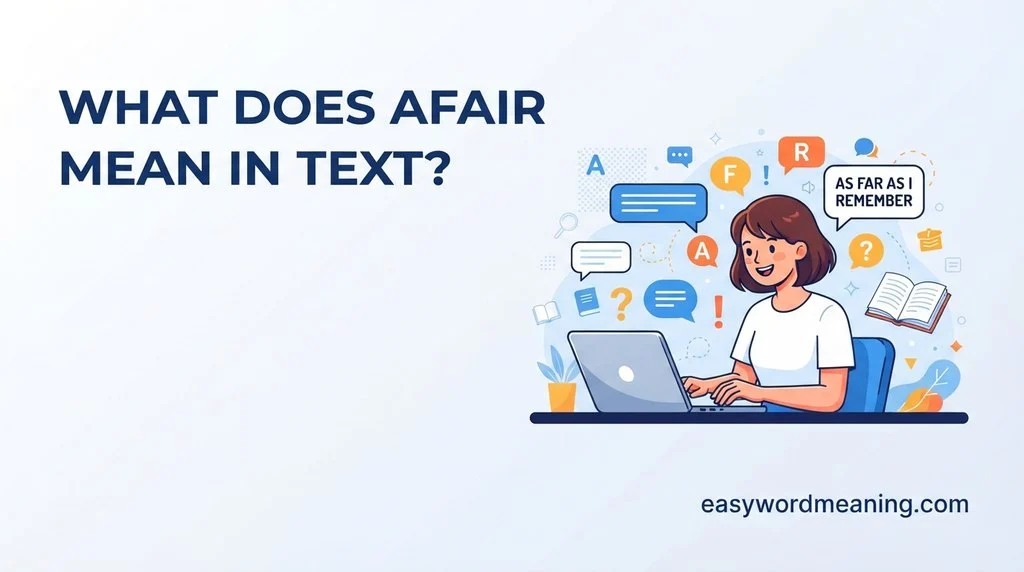
AFAIR stands for “As Far As I Remember.” It is an informal abbreviation used when someone wants to share something based on their recollection.
Instead of typing the complete phrase, people use AFAIR to keep their messages short and direct. It is especially useful when discussing previous conversations, past events, appointments, or information that someone remembers imperfectly.
For example:
- “AFAIR, we met last summer.”
- “AFAIR, she said the deadline was Friday.”
- “AFAIR, that restaurant closes at 9 PM.”
- “AFAIR, you already sent me the document.”
In each example, the speaker is explaining what they remember without claiming that their memory is necessarily perfect.
What Is the Full Form of AFAIR?
The full form of AFAIR is As Far As I Remember.
Here is how the abbreviation breaks down:
- A — As
- F — Far
- A — As
- I — I
- R — Remember
The phrase indicates that the information comes from the speaker’s memory. It is a useful way to express uncertainty politely without making an entire message sound hesitant.
Does AFAIR Have Other Meanings?
Although As Far As I Remember is a common interpretation of AFAIR in online conversations, abbreviations can have different meanings depending on the community and context.
For instance, some people use AFAIR to mean “As Far As I Recall.” This is a closely related expression that communicates almost the same idea.
The safest approach is to examine the surrounding message. If someone is discussing a past event, previous instructions, or something they were told earlier, AFAIR probably refers to their memory of that information.
Where Did AFAIR Originate?
AFAIR belongs to the broader family of internet abbreviations that developed as people began communicating through online chat rooms, discussion boards, email, and instant messaging.
In early internet conversations, users often shortened common expressions to save typing time and make discussions move faster. Abbreviations such as IMO, IMHO, and AFAIK became familiar ways to express opinions, qualify statements, and communicate uncertainty.
AFAIR follows the same general pattern. Rather than typing “As far as I remember,” a person can use five letters to convey the same basic message.
However, there is no single, universally established origin date for AFAIR. Its exact first use is difficult to determine, and it is better understood as part of the natural development of online shorthand.
Today, you may encounter it in private messages, community forums, work chats, gaming discussions, and social media comments.
How to Use AFAIR in Texts or Chat
Using AFAIR is simple once you understand its purpose. You can use it whenever you want to share something you remember while leaving room for the possibility that you may have forgotten a detail.
Here are some common situations where it fits naturally.
1. When Talking About Past Events
AFAIR works well when discussing something that happened previously.
Example:
Friend 1: “When did we go to that concert?”
Friend 2: “AFAIR, it was sometime in August.”
The second person is sharing their recollection without claiming to remember the exact date.
2. When Recalling Previous Conversations
People often forget the precise wording of a conversation. AFAIR helps communicate what they remember.
Example:
Alex: “Did Sarah say she was joining us?”
Jamie: “AFAIR, she said she would try to come.”
This response makes it clear that Jamie remembers Sarah’s answer as a possibility rather than a definite commitment.
3. When Discussing Plans or Schedules
You can use AFAIR when remembering appointments, deadlines, or meeting times.
Example:
Coworker: “What time is our meeting tomorrow?”
You: “AFAIR, it’s at 11 AM, but I’ll check the calendar.”
This is a practical use because it shares the information you remember while acknowledging that verification may be necessary.
4. When Answering Questions Online
AFAIR is also useful in online forums where users share information based on their experiences.
Example:
User 1: “Does this game have a multiplayer mode?”
User 2: “AFAIR, it does, but I haven’t played it in a while.”
The abbreviation helps distinguish remembered information from something the person has recently confirmed.
5. When Chatting Casually With Friends
Friends often use abbreviations to keep conversations quick and relaxed.
Example:
Friend 1: “Wasn’t that movie released in 2022?”
Friend 2: “AFAIR, yes! I watched it around that time.”
This sounds natural in an informal conversation and avoids the need for a longer explanation.
AFAIR Meaning on Social Media
The meaning of AFAIR generally stays the same across social media platforms: As Far As I Remember.
However, the situations in which people use it can vary.
AFAIR on WhatsApp
On WhatsApp, AFAIR can appear in private chats, family groups, or work-related conversations.
Example:
“ AFAIR, Uncle Ahmed said dinner would be at 8.”
The sender is sharing what they remember and may not be completely certain about the timing.
AFAIR on Instagram
On Instagram, you might see AFAIR in direct messages or comments discussing a previous post, event, or conversation.
Example:
“AFAIR, you posted this last year!”
The person believes they remember seeing the content earlier.
AFAIR on Reddit and Online Forums
Discussion forums are particularly suitable for abbreviations that qualify statements. Users frequently discuss older posts, software versions, game features, and personal experiences.
Example:
“AFAIR, this feature was introduced in an earlier update.”
The person is offering a recollection rather than guaranteeing that the information is correct.
AFAIR in Gaming Chats
Gamers may use AFAIR when discussing previous matches, game mechanics, character abilities, or updates.
Example:
“AFAIR, the boss becomes easier after the second phase.”
This communicates remembered gameplay information while leaving room for correction.
Important: These examples illustrate natural ways the abbreviation can be used. They do not establish that AFAIR is equally popular on every platform or among every group of users.
Examples of AFAIR in Everyday Conversations
The easiest way to understand an abbreviation is to see how it works in real-life situations. Below are several sample conversations using AFAIR naturally.
Example 1: Remembering a Birthday
Mia: “When is Daniel’s birthday?”
Leo: “AFAIR, it’s on the 14th of June.”
Meaning: Leo remembers the birthday as June 14 but is not completely certain.
Example 2: Discussing Homework
Student 1: “What chapters do we need to study?”
Student 2: “AFAIR, chapters 3 and 4.”
Meaning: The student remembers chapters 3 and 4 being assigned.
Example 3: Making Weekend Plans
Friend 1: “Didn’t we plan to meet at the coffee shop?”
Friend 2: “AFAIR, yes, around 5 PM.”
Meaning: The friend remembers the plan but may need to confirm the time.
Example 4: Remembering a Recommendation
Sam: “What was the name of that book you recommended?”
Taylor: “AFAIR, it was called The Midnight Library.”
Meaning: Taylor believes that was the book’s title based on memory.
Example 5: Talking About a Purchase
Customer: “Was this phone released in 2023?”
Friend: “AFAIR, yes, but check the manufacturer’s website.”
Meaning: The friend recalls that the release was in 2023 but recommends checking an authoritative source.
Example 6: Remembering an Appointment
Person 1: “Is the dentist appointment today or tomorrow?”
Person 2: “AFAIR, it’s tomorrow morning.”
Meaning: The person thinks the appointment is tomorrow but has not confirmed it.
Example 7: Discussing a Previous Message
Friend 1: “Did I send you the pictures?”
Friend 2: “AFAIR, you sent them on Monday.”
Meaning: The person remembers receiving the pictures on Monday.
Example 8: Talking About a School Event
Student 1: “Is the school festival next week?”
Student 2: “AFAIR, it’s on Thursday.”
Meaning: The student recalls Thursday as the date but may need to verify it.
These examples show that AFAIR is most useful when the speaker remembers something but wants to avoid presenting that memory as an unquestionable fact.
How to Reply When Someone Says AFAIR
If someone sends you a message containing AFAIR, you can respond according to the situation. You usually do not need to acknowledge the abbreviation itself.
If You Agree With Their Memory
You can confirm the information if you also remember it.
Examples:
- “Yes, that’s what I remember too.”
- “I think you’re right!”
- “Yeah, that sounds familiar.”
- “That’s what I had in mind as well.”
If You Want to Verify the Information
If the detail matters, ask the person to check it.
Examples:
- “Could you double-check the date?”
- “Let’s check the calendar to be sure.”
- “Can you look at the original message?”
- “I’ll confirm it on my end.”
If You Remember Something Different
You can politely explain your recollection.
Examples:
- “I thought it was Friday, but I could be wrong.”
- “AFAIR, we agreed on Saturday.”
- “Maybe we’re remembering different conversations.”
- “Let’s check our messages to settle it.”
The best response depends on how important the information is. For a casual conversation, a shared recollection may be enough. For appointments, deadlines, payments, or travel plans, checking a reliable source is usually better.
AFAIR vs. AFAIK: What’s the Difference?
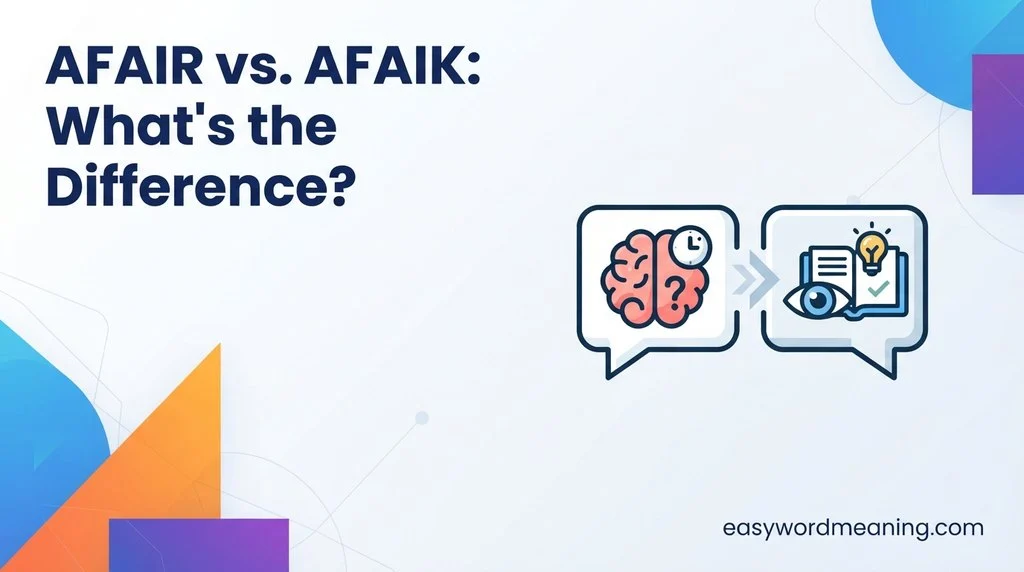
AFAIR and AFAIK look similar, but they express slightly different ideas.
AFAIR means “As Far As I Remember.” It emphasizes what someone recalls from memory.
AFAIK means “As Far As I Know.” It emphasizes what someone currently knows or believes to be true.
Compare these examples:
- AFAIR: “AFAIR, we submitted the application last Tuesday.”
- AFAIK: “AFAIK, the application process is still open.”
In the first example, the person is recalling a past action. In the second, the person is sharing their understanding of the current situation.
Neither abbreviation guarantees that the information is correct. Both can be used to signal that the speaker is allowing for uncertainty.
AFAIR vs. IMO and Other Text Abbreviations
Several other abbreviations serve a similar purpose in digital conversations, but their meanings are different.
| Abbreviation | Full form | Meaning or purpose |
|---|---|---|
| AFAIR | As Far As I Remember | Shares a recollection |
| AFAIK | As Far As I Know | Shares current knowledge with some uncertainty |
| IMO | In My Opinion | Introduces a personal opinion |
| IMHO | In My Humble Opinion | Introduces an opinion, often modestly |
| IIRC | If I Recall Correctly | Signals an uncertain recollection |
| FYI | For Your Information | Shares useful information |
| TBH | To Be Honest | Introduces an honest or candid statement |
| BTW | By The Way | Adds another point to a conversation |
AFAIR vs. IIRC
AFAIR and IIRC are especially close in meaning.
AFAIR means “As Far As I Remember,” while IIRC means “If I Recall Correctly.”
Both can be used when discussing something from memory.
For example:
- “AFAIR, the shop closes at 6 PM.”
- “IIRC, the shop closes at 6 PM.”
Both sentences communicate uncertainty about the closing time.
The main difference is phrasing. AFAIR directly refers to the speaker’s memory, whereas IIRC frames the statement as conditional on remembering correctly.
Common Mistakes and Misunderstandings About AFAIR
Although AFAIR is easy to understand, there are a few mistakes worth avoiding.
1. Confusing AFAIR With AFAIK
These abbreviations are related, but they are not interchangeable in every situation.
Use AFAIR when referring to something you remember. Use AFAIK when referring to what you currently know or understand.
2. Assuming It Means the Information Is Definitely Correct
AFAIR does not guarantee accuracy. In fact, it often suggests that the person may be uncertain.
If someone says, “AFAIR, the deadline is tomorrow,” it is wise to verify the deadline rather than assume it is confirmed.
3. Using It in Every Formal Message
AFAIR is suitable for casual digital communication, online discussions, and many workplace chats. However, writing the complete phrase may be clearer in formal emails, official reports, or messages to people who are unfamiliar with internet abbreviations.
For example, instead of writing:
“AFAIR, the contract was approved last week.”
You could write:
“As far as I remember, the contract was approved last week.”
For important business communication, it may be better to check the records and state the verified date.
4. Assuming Everyone Knows the Abbreviation
Not everyone uses the same internet slang. Some readers may not recognize AFAIR, especially if they rarely participate in online forums or chat communities.
If clarity matters, write the full phrase the first time you use it.
5. Treating It as a Sign of Dishonesty
Using AFAIR does not automatically mean someone is hiding information or avoiding responsibility. Often, it simply shows that they are trying to be accurate about the limits of their memory.
Acknowledging uncertainty can actually make a conversation more honest and helpful.
Is AFAIR Formal or Informal?
AFAIR is primarily an informal abbreviation. It is most appropriate for conversations where short forms and casual language are expected.
Suitable situations include:
- Text messages with friends and family
- WhatsApp and other messaging apps
- Reddit discussions and online forums
- Gaming chats
- Informal workplace conversations
- Casual social media comments
Situations where the full phrase may be better include:
- Formal business correspondence
- Academic writing
- Official documents
- Legal or financial communication
- Messages where the reader may not understand internet slang
The key is to consider your audience. If the recipient understands common chat abbreviations, AFAIR can make your message concise. If not, spelling out the phrase can prevent confusion.
Is AFAIR Still Used in 2025 and Beyond?
AFAIR remains understandable as part of established internet shorthand, although individual usage varies across communities and platforms. There is not enough information here to claim that it is currently trending or becoming more popular.
As digital communication evolves, people continue to use abbreviations to save time and express ideas efficiently. Familiar forms such as AFAIR, AFAIK, and IIRC can still be useful in online discussions, particularly when someone wants to distinguish remembered information from confirmed facts.
For readers learning modern texting language, understanding these abbreviations is less about memorizing every short form and more about recognizing how context shapes meaning.
If you encounter AFAIR in a conversation, look at what the person is discussing. When the topic involves a previous event, an old message, or something they recall, “As Far As I Remember” is a sensible interpretation.
For time-sensitive details, such as a meeting time or a payment deadline, always confirm the information rather than relying entirely on someone’s memory.
FAQs:
1. What does AFAIR mean in texting?
AFAIR means “As Far As I Remember.” People use it when sharing information they recall but are not completely certain about. It is common in informal messages and online discussions.
2. What does AFAIR mean on WhatsApp?
On WhatsApp, AFAIR generally means “As Far As I Remember.” For example, “AFAIR, we agreed to meet at 6” means the sender remembers the meeting time as 6 PM but may need to confirm it.
3. Is AFAIR the same as AFAIK?
No. AFAIR means “As Far As I Remember,” while AFAIK means “As Far As I Know.” AFAIR emphasizes memory, whereas AFAIK emphasizes current knowledge or understanding.
4. What is the difference between AFAIR and IIRC?
AFAIR stands for “As Far As I Remember,” while IIRC stands for “If I Recall Correctly.” Both are used when sharing information from memory, and their meanings often overlap in casual conversations.
5. Can I use AFAIR in professional messages?
Yes, AFAIR can be acceptable in informal workplace chats when colleagues understand the abbreviation. In formal emails, official documents, or important business discussions, writing “as far as I remember” or verifying the facts is usually clearer.
Conclusion:
Understanding AFAIR meaning in text helps you follow online conversations and communicate more clearly. The abbreviation usually stands for “As Far As I Remember” and is used when someone shares information based on memory rather than complete certainty.
You may see AFAIR in text messages, social media comments, gaming chats, and online forums. Remember that it differs from AFAIK, which refers to what someone knows, and IIRC, which refers to recalling something correctly. When a detail is important, always verify it instead of relying only on memory.

Hi, I’m Musaghumman, the mind behind EasyWordMeaning. I turn confusing words into easy meanings so anyone can learn, understand, and use English with confidence.