If you have ever seen someone write “that’s funny AF” or “I’m tired AF” and wondered what AF meaning is, you’re not alone. This short abbreviation appears frequently in texts, social media posts, comments, memes, and online chats.
AF usually means “as f*”** (a censored form of a profanity). It is used to strongly emphasize an adjective or description. For example, “cold AF” means extremely cold, while “happy AF” means extremely happy.
What Does AF Mean in Text?
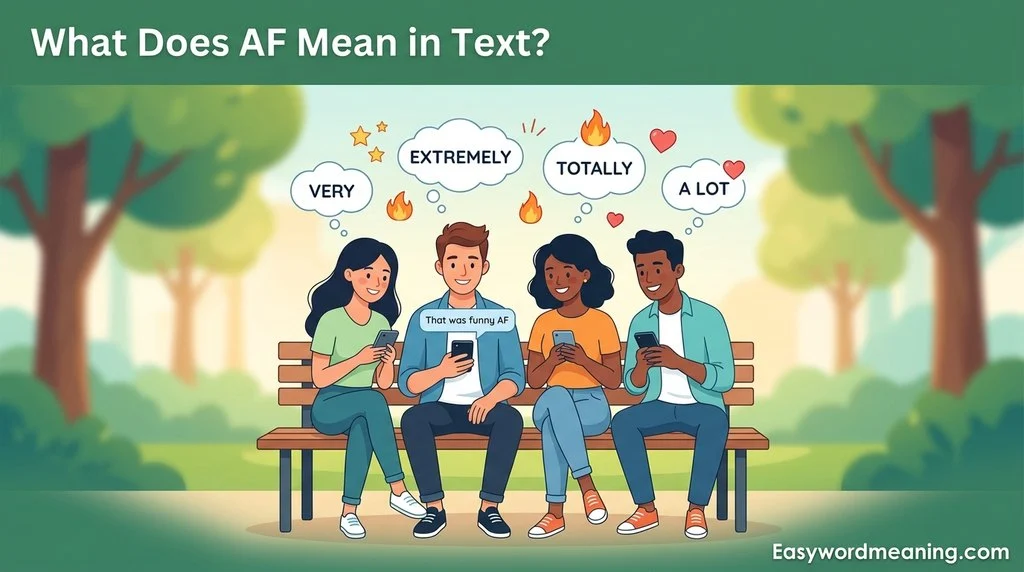
The most common AF meaning in texting is “as f*.”**
The abbreviation works as an intensifier. In simple terms, it adds strong emphasis to whatever word comes before it.
For example:
- Tired AF = Extremely tired
- Funny AF = Extremely funny
- Cold AF = Very cold
- Happy AF = Extremely happy
- Busy AF = Extremely busy
Because the original phrase contains profanity, AF is considered informal and somewhat vulgar, even though the abbreviated form is often used casually.
AF Meaning in Simple Words
Think of AF as a way to say “very,” “extremely,” or “really” with much stronger emphasis.
For example:
“This movie is funny AF.”
“This movie is extremely funny.”
The abbreviation gives the sentence a more casual, expressive, and sometimes humorous tone.
What Is the Origin of AF?
The phrase behind AF has existed as an emphatic expression for a long time, but the abbreviation became especially common with internet culture, texting, social media, and online communities.
As people began looking for shorter ways to communicate online, phrases were frequently shortened into initials or abbreviations. AF became a convenient way to express strong emphasis without writing the complete phrase.
It became particularly recognizable through:
- Text messaging
- Social media
- Internet memes
- Online forums
- Gaming communities
- Comment sections
- Casual conversations
Today, AF is widely understood in informal online communication.
However, its meaning can depend on context. In most casual texting situations, it refers to the profanity-based intensifier. In a completely different context, AF can have other meanings, so you should consider the surrounding conversation.
What Does AF Mean on Social Media?
On social media, AF is generally used to emphasize a feeling, opinion, or description.
You might see captions such as:
- “This outfit is cute AF.”
- “That concert was loud AF.”
- “I’m hungry AF.”
- “The weather is hot AF.”
- “This cat is adorable AF.”
In these examples, AF doesn’t introduce a new idea. Instead, it makes the preceding description much stronger.
Social media users often choose AF because it is short, recognizable, and expressive.
AF in Instagram Captions
Instagram captions frequently use informal language, and AF can fit naturally into casual posts.
For example:
“Feeling confident AF today.”
This means the person feels extremely confident.
Another example:
“Weekend vibes AF.”
Here, the writer is emphasizing the overall feeling or mood of the post.
Because Instagram posts can be viewed by many different audiences, remember that AF is still associated with profanity. It may not be appropriate for professional or family-oriented content.
How to Use AF in Text Messages
Using AF is relatively simple.
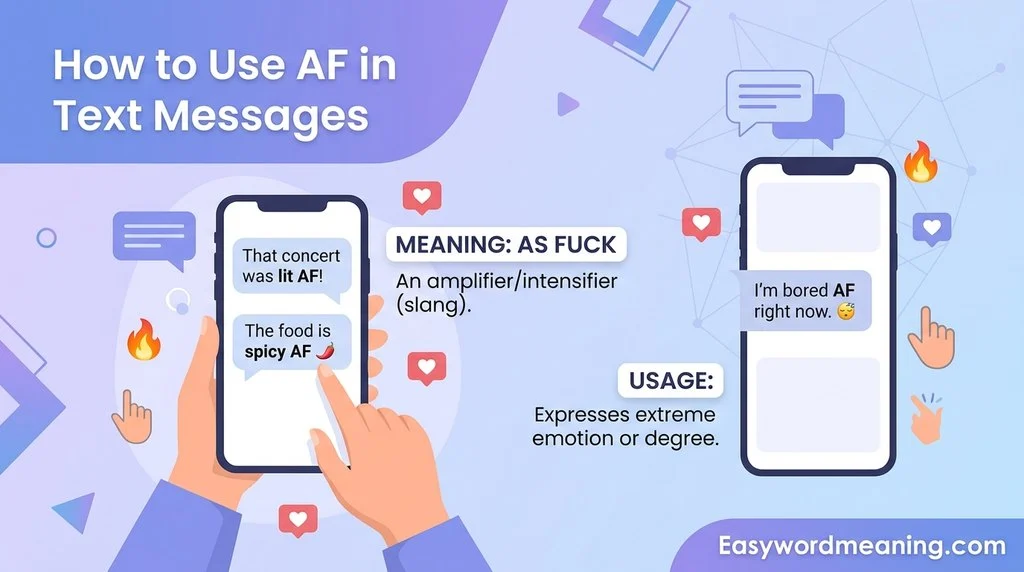
Basic Formula
A common structure is:
Adjective + AF
Examples:
- exhausted AF
- excited AF
- nervous AF
- hungry AF
- tired AF
- cute AF
- expensive AF
- annoying AF
You can also see AF used after short descriptive phrases in casual online communication.
Example Conversation
Alex: How was your exam?
Sam: Hard AF. I barely finished it.
Here, “hard AF” means extremely difficult.
Another example:
Alex: Are you ready for the party?
Sam: Not even close. I’m tired AF.
The speaker is saying they are extremely tired.
AF Meaning in Different Contexts
The meaning and tone of AF can change slightly depending on where you see it.
1. In Texting
In private messages between friends, AF is usually casual and expressive.
Example:
“I’m bored AF right now.”
Meaning:
“I’m extremely bored right now.”
2. On Social Media
AF is often used for humorous captions, reactions, and comments.
Example:
“That puppy is cute AF.”
The writer strongly emphasizes how cute the puppy is.
3. In Memes
Memes commonly use AF to exaggerate a situation.
Example:
“Me trying to wake up on Monday: tired AF.”
The humor comes from exaggerating how exhausted someone feels.
4. In Gaming Chats
Gamers may use AF to describe intense experiences.
Example:
“That final boss was difficult AF.”
The writer means the boss was extremely difficult.
5. In Online Forums
AF can appear in informal discussions and comments.
Example:
“That update made the app slow AF.”
Again, AF intensifies “slow.”
AF Meaning in a Conversation
Understanding the tone of AF is just as important as knowing its literal meaning.
Consider this:
Person 1: Are you ready?
Person 2: I’m nervous AF.
The person isn’t necessarily being rude. They’re using casual slang to emphasize their nervousness.
Now consider:
Manager: Please describe the project using formal language.
Writing “The project is complicated AF” would probably be inappropriate.
A more suitable version would be:
“The project is extremely complicated.”
The meaning is similar, but the tone is completely different.
15 Examples of AF in Texting
Here are some realistic examples of how people may use AF online:
- I’m hungry AF right now.
- That joke was funny AF.
- This coffee is strong AF.
- She looked confident AF.
- I’m tired AF after work.
- That game was intense AF.
- This bag is expensive AF.
- The room is cold AF.
- That puppy is cute AF.
- I’m excited AF for the weekend.
- This traffic is annoying AF.
- The movie was scary AF.
- He runs fast AF.
- That test was difficult AF.
- The sunset looks beautiful AF.
The common pattern is clear: AF strengthens the word or description immediately before it.
Can AF Be Used in a Positive Way?
Yes. AF isn’t automatically negative.
It can emphasize positive feelings or compliments.
For example:
- Beautiful AF
- Happy AF
- Cute AF
- Strong AF
- Amazing AF
- Funny AF
- Confident AF
Someone saying “You look amazing AF” is generally emphasizing a compliment.
The important point is that the abbreviation contributes an informal and profane tone, even when the underlying statement is positive.
Can AF Be Used in a Negative Way?
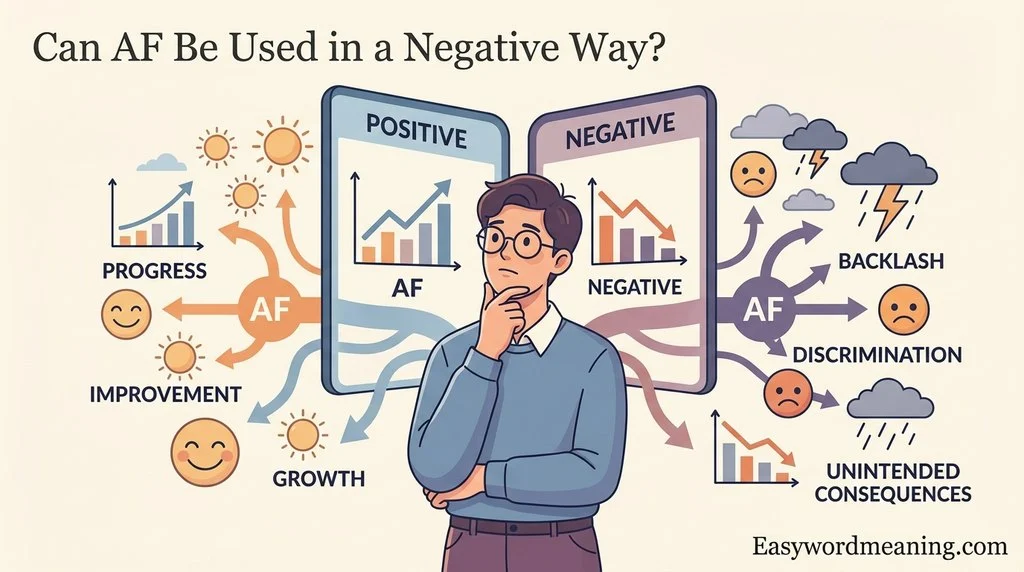
Yes.
AF can emphasize negative feelings, criticism, or unpleasant situations.
Examples include:
- Angry AF
- Annoying AF
- Boring AF
- Expensive AF
- Confusing AF
- Stressful AF
For example:
“This assignment is confusing AF.”
The speaker means the assignment is extremely confusing.
Is AF a Bad Word?
AF is considered profanity because it abbreviates a phrase containing a vulgar word.
That doesn’t mean people never use it. In fact, it is common in informal internet language. But the setting matters.
AF is generally more acceptable in:
- Private chats with friends
- Casual social media posts
- Memes
- Informal online communities
- Gaming conversations
AF is usually better avoided in:
- Job applications
- Formal emails
- School assignments
- Business documents
- Professional presentations
- Messages to people you don’t know well
If you’re unsure whether slang is appropriate, use “very” or “extremely” instead.
Common Mistakes When Using AF
Although AF is simple, people can misunderstand its tone.
Mistake 1: Using It in Formal Writing
Writing:
“The report is long AF.”
may be understandable, but it is not professional.
Use:
“The report is extremely long.”
instead.
Mistake 2: Assuming AF Always Has One Meaning
AF can have other meanings outside internet slang. For example, in technical, medical, organizational, or professional contexts, AF may stand for completely different terms.
Always examine the surrounding conversation.
Mistake 3: Forgetting the Tone
Some people assume AF is completely harmless because it is abbreviated. However, it still carries the tone of the original profanity.
That’s why context matters.
Mistake 4: Using It With Everyone
Something that sounds funny between close friends might sound disrespectful to a teacher, manager, customer, or older relative.
Knowing the meaning is only half the skill. Knowing when to use it is equally important.
AF vs. Very vs. Extremely
These words can communicate a similar basic idea, but their tone differs.
| Expression | Meaning | Tone |
|---|---|---|
| Very tired | Strong degree of tiredness | Neutral |
| Extremely tired | Very strong degree | Neutral/formal |
| Tired AF | Extremely tired | Casual/profane |
| Really tired | Strong degree | Casual/neutral |
For example:
“I’m extremely hungry.”
Sounds neutral.
“I’m hungry AF.”
Sounds casual, exaggerated, and more expressive.
AF vs. ASF
You may also encounter ASF online.
ASF is sometimes used as another shortened version of the same profanity-based expression. However, usage can vary between communities and individuals.
For someone simply asking “what does AF mean in text?”, the standard slang interpretation is the profanity-based intensifier described above.
AF vs. LOL, OMG, and Other Text Slang
AF belongs to a much larger world of internet abbreviations.
Here are a few related examples:
- LOL — Laughing out loud
- OMG — Oh my God
- TBH — To be honest
- IDK — I don’t know
- IMO — In my opinion
- FYI — For your information
- BRB — Be right back
- BTW — By the way
- LMK — Let me know
- SMH — Shaking my head
Unlike many of these abbreviations, AF mainly functions as an intensifier rather than expressing a complete idea on its own.
When Should You Use AF?
Use AF when you want to make an informal statement sound more intense or expressive and you’re comfortable with the profanity involved.
A quick checklist can help:
Use AF when:
- You’re chatting casually with friends.
- You’re posting informal social media content.
- You’re participating in a relaxed online community.
- The people reading it understand internet slang.
- The situation isn’t professional.
Avoid AF when:
- You’re writing professionally.
- You’re communicating with a client.
- You’re submitting school or academic work.
- You’re unsure whether the audience accepts profanity.
- You need a polite or formal tone.
Funny AF Meaning Examples
Internet users often use AF for exaggeration, which can make ordinary sentences sound humorous.
Imagine someone opening the refrigerator at midnight and saying:
“I’m hungry AF, but there’s nothing here.”
Or someone walking outside during winter:
“It’s cold AF today.”
The abbreviation makes the sentence feel more dramatic and conversational.
That’s one reason internet slang works so well in memes: a tiny abbreviation can add a lot of personality.
FAQs:
What does AF mean in texting?
AF usually means “as f*”** and is used to emphasize something. For example, “tired AF” means “extremely tired.”
What does AF mean on Instagram?
On Instagram, AF usually has the same slang meaning. People use it in captions, comments, and posts to strongly emphasize an adjective or description.
Is AF considered slang?
Yes. AF is internet and texting slang. It is most common in casual communication rather than formal writing.
Is AF rude?
It can be considered rude or inappropriate because it represents a phrase containing profanity. Whether it sounds offensive depends heavily on the audience and context.
Can I use AF at work?
It’s generally safer to avoid AF in professional communication. Words such as “very” or “extremely” communicate the same basic emphasis without the profanity.
Final Thoughts:
The most common AF meaning in text is “as f*.”** It works as an intensifier, making descriptions such as “tired,” “funny,” “cold,” or “happy” much stronger. You’ll commonly see it in texting, social media captions, memes, gaming chats, and other informal online conversations.
The biggest thing to remember is context. AF is widely understood, but it still carries a profane and casual tone. Use it with people and in situations where that style of communication is appropriate.

Hi, I’m Musaghumman, the mind behind EasyWordMeaning. I turn confusing words into easy meanings so anyone can learn, understand, and use English with confidence.