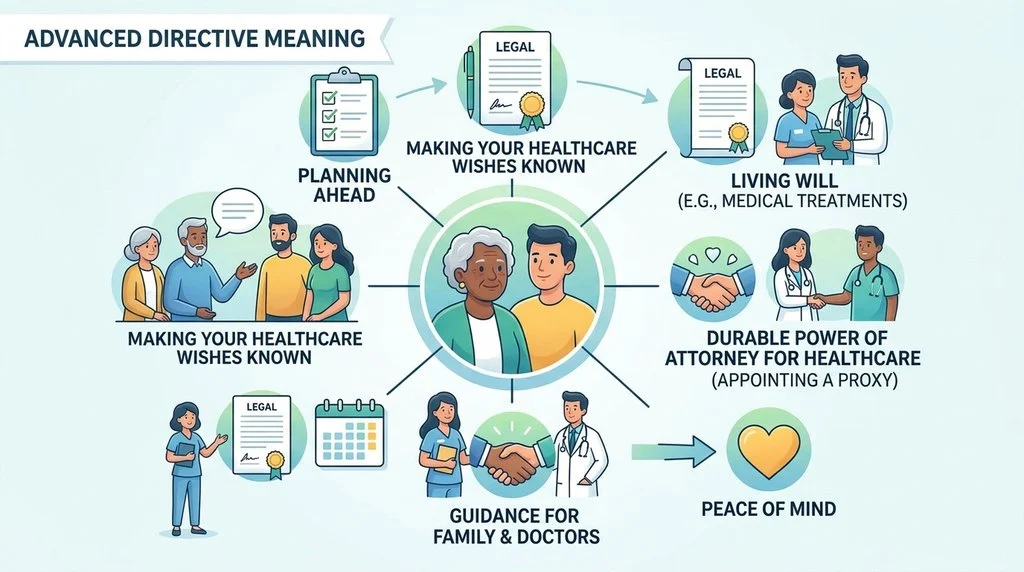
If you’ve searched for advanced directive meaning, you may have encountered the phrase in a medical, legal, or healthcare context and wondered exactly what it refers to. Unlike internet slang or texting abbreviations, advanced directive is a formal term used to describe instructions about a person’s future medical care.
Understanding the term matters because an advance directive can help communicate a person’s healthcare wishes if they later become unable to make or communicate decisions themselves. The exact rules, documents, and legal effects can vary by country or jurisdiction.
Note: The standard spelling is usually “advance directive,” not “advanced directive.” People commonly search for “advanced directive meaning,” so this article uses that search phrase while explaining the standard term.
What Does “Advanced Directive” Mean?
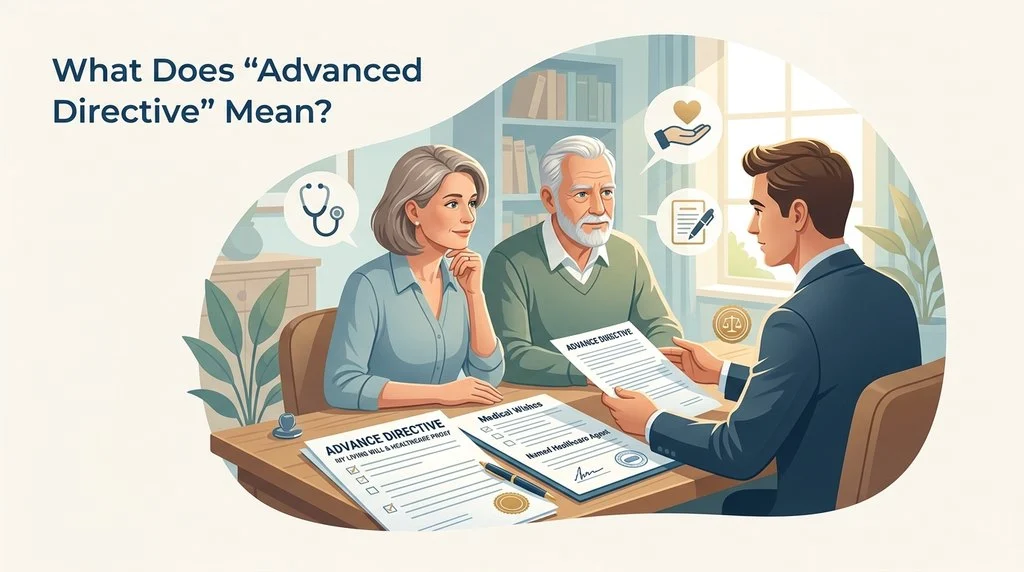
Advanced directive meaning generally refers to a written or legally recognized instruction about the medical care a person wants—or does not want—if they become unable to make healthcare decisions for themselves.
The more commonly accepted term is advance directive.
For example, someone might document their preferences about certain medical treatments before an illness or accident leaves them unable to communicate. Depending on local law, an advance directive may also allow someone to appoint another person to make healthcare decisions on their behalf.
In simple terms:
An advance directive = instructions for future healthcare decisions.
It can help answer an important question:
“What should happen with my medical care if I cannot speak or decide for myself?”
Why Is It Called an “Advance” Directive?
The word advance means that the instructions are prepared ahead of time.
A person does not necessarily need to be seriously ill to create one. The purpose is to make healthcare preferences known before a situation arises in which the person cannot communicate them.
Advance Directive Definition in Simple Words
Here is an easy definition:
An advance directive is a document or legally recognized instruction that communicates a person’s healthcare wishes for a future situation in which they may be unable to make or communicate medical decisions.
The exact legal definition differs depending on where you live.
An advance directive can be useful because family members may not automatically know what a person would want in an emergency or serious illness.
A Simple Example
Imagine someone is involved in a serious accident and becomes unconscious.
Doctors need to make important healthcare decisions, but the person cannot communicate.
If that person previously created an appropriate advance directive, healthcare professionals and family members may have information about the person’s wishes, subject to applicable law.
That is the basic idea behind an advance directive.
What Is an Advance Directive Used For?
An advance directive can communicate healthcare preferences for situations where someone cannot make their own decisions.
Depending on the jurisdiction and document, it may address issues such as:
- Certain life-sustaining treatments
- End-of-life care preferences
- Resuscitation decisions
- Artificial nutrition or hydration
- Who should make healthcare decisions
- Personal values and treatment preferences
However, not every advance directive covers all of these issues. The contents and legal effect depend on the document and applicable law.
Types of Advance Directives
The term advance directive can refer to different types of healthcare planning documents.
Two commonly discussed forms are a living will and a healthcare proxy or healthcare power of attorney.
1. Living Will
A living will generally describes a person’s wishes regarding certain medical treatments, particularly in serious or end-of-life situations.
For example, it might explain preferences concerning life-sustaining treatment if the person becomes permanently unable to communicate.
A living will is therefore focused primarily on treatment instructions.
2. Healthcare Power of Attorney
A healthcare power of attorney, healthcare proxy, or similar document may allow a person to appoint someone else to make healthcare decisions if they cannot make them personally.
The terminology varies considerably between jurisdictions.
The appointed person may be called a:
- Healthcare agent
- Healthcare proxy
- Medical power of attorney
- Healthcare representative
The exact authority of that person depends on local law and the document itself.
3. Other Healthcare Planning Documents
Some jurisdictions use additional documents for specific medical decisions.
For example, there may be separate forms concerning emergency medical treatment or resuscitation.
This is why searching for a generic advanced directive meaning does not always provide enough information to understand the legal process in a particular location.
How Does an Advance Directive Work?
The process is generally about making healthcare preferences known before they are needed.
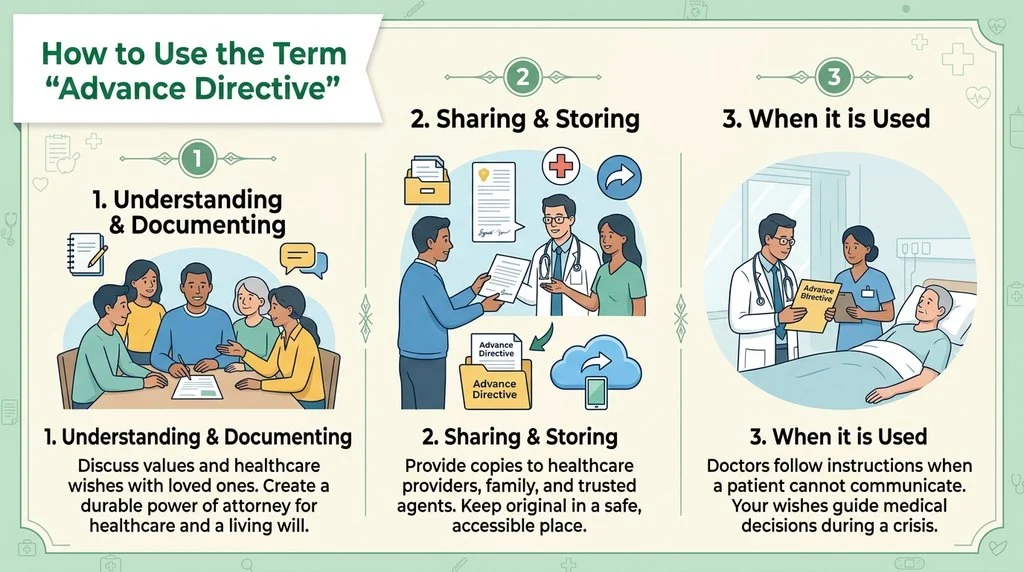
A simplified process looks like this:
- Think about your healthcare preferences.
- Learn which documents are recognized where you live.
- Complete the appropriate document.
- Follow applicable signing or witnessing requirements.
- Tell trusted people about your wishes.
- Give relevant healthcare providers access to the document when appropriate.
- Review it periodically and update it when your wishes change.
Requirements can vary, so legal or healthcare guidance may be appropriate when completing an advance directive.
How to Use the Term “Advance Directive”
Unlike texting abbreviations, advance directive is not usually something people use casually in messages.
It appears more often in:
- Medical conversations
- Healthcare websites
- Legal documents
- Hospital paperwork
- Patient education materials
- Discussions about future healthcare planning
- Family conversations about medical preferences
Example Sentences
Here are some natural examples:
- “Have you completed an advance directive?”
- “The hospital asked whether the patient had an advance directive.”
- “She discussed her advance directive with her family.”
- “An advance directive can communicate healthcare preferences in advance.”
- “We should find out what documents are recognized in our jurisdiction.”
Advanced Directive vs. Advance Directive
This is one of the most important points for people searching advanced directive meaning.
“Advance Directive”
Advance directive is the standard term commonly used for future healthcare instructions.
“Advanced Directive”
Advanced directive is a common variation people type or say, but in this context, advance directive is generally the preferred expression.
The difference is small but meaningful.
Advance means something prepared ahead of time.
Advanced generally means something developed, sophisticated, or further along.
So, when discussing future healthcare wishes, you will commonly see:
Advance directive ✅
rather than:
Advanced directive ⚠️
Search engines may still return results for “advanced directive meaning” because people frequently use that wording when looking for information about advance directives.
Advance Directive vs. Living Will
These terms are sometimes treated as if they mean exactly the same thing, but they can have different meanings.
An advance directive is a broader term for advance healthcare instructions or arrangements.
A living will is generally a specific type of document that records treatment preferences.
Think of it this way:
| Term | General Meaning |
|---|---|
| Advance directive | Broader category of advance healthcare instructions |
| Living will | Document describing certain treatment preferences |
| Healthcare proxy | Person authorized to make healthcare decisions in certain circumstances |
| Healthcare power of attorney | Legal mechanism that may appoint a healthcare decision-maker |
The exact terminology depends on the jurisdiction.
Advance Directive vs. DNR
Another common misunderstanding involves DNR, which means Do Not Resuscitate.
A DNR order generally concerns whether cardiopulmonary resuscitation should be attempted if a person’s heart stops or they stop breathing, depending on the applicable medical and legal framework.
An advance directive is broader.
An advance directive may communicate preferences about various aspects of future medical care, while a DNR specifically addresses resuscitation.
Therefore:
Advance directive ≠ DNR
They can be related, but they are not automatically the same thing.
Related Terms You May Want to Know
If you searched for advanced directive meaning, these related terms may also be useful:
- Advance directive
- Living will
- Healthcare proxy
- Healthcare agent
- Medical power of attorney
- Do Not Resuscitate (DNR)
- End-of-life care
- Life-sustaining treatment
- Healthcare decision-making
- Patient autonomy
Understanding these terms together makes healthcare-planning information much easier to follow.
Why Understanding Advance Directives Matters
Medical decisions can become complicated when someone is unable to communicate.
An advance directive can provide a way for a person to express preferences beforehand. It may also give family members and healthcare professionals useful information about the person’s wishes, depending on the document and applicable law.
The most important point is that an advance directive is about planning ahead for healthcare decisions, not about texting slang or internet abbreviations.
Who Can Create an Advance Directive?
Eligibility requirements vary by jurisdiction.
Generally, advance healthcare planning is intended for adults who have the legal capacity required to make healthcare decisions.
Local rules may determine:
- Minimum age
- Mental or legal capacity
- Required signatures
- Witness requirements
- Notarization requirements
- Who can act as a healthcare agent
- How the document can be changed or revoked
Because these rules differ, information from one country or state should not automatically be applied somewhere else.
When Should Someone Make an Advance Directive?
There is no universal moment when everyone must create one.
People may consider advance healthcare planning when:
- They are healthy and want to plan ahead.
- They are preparing for a major medical procedure.
- They have been diagnosed with a serious illness.
- They are getting older.
- They are reviewing important legal or family documents.
- Their healthcare preferences have changed.
The central idea is simple: planning ahead can make a person’s wishes clearer if they later cannot communicate them.
Can an Advance Directive Be Changed?
In many jurisdictions, a person can change or revoke an advance directive while they have the required decision-making capacity.
However, the procedure for making changes can vary.
If someone creates a new document, it may also be important to make sure relevant healthcare providers and trusted people know that an earlier version has been replaced.
When Should You Review It?
Consider reviewing an advance directive after major life or healthcare changes, such as:
- Marriage or divorce
- A significant change in family relationships
- A major diagnosis
- A change in treatment preferences
- Moving to another jurisdiction
- A change in the person appointed to make healthcare decisions
Again, local legal requirements matter.
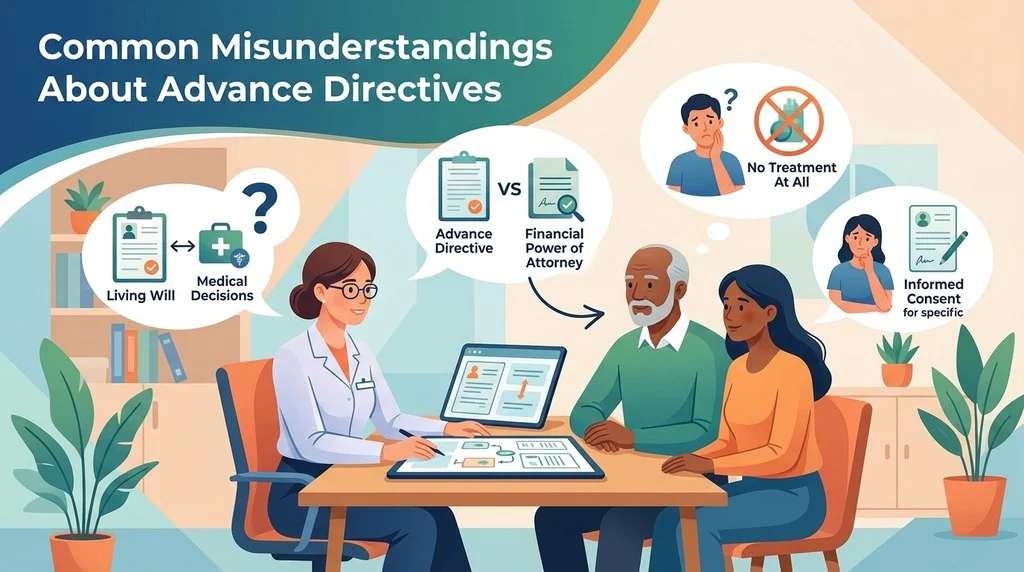
Common Misunderstandings About Advance Directives
1. “It is only for elderly people.”
Not necessarily.
Advance healthcare planning can be relevant to adults of different ages because unexpected accidents and illnesses can happen at any time.
2. “An advance directive means refusing all treatment.”
Not necessarily.
An advance directive can communicate preferences about particular treatments or appoint someone to make decisions. It does not automatically mean that a person wants no medical care.
3. “My family automatically knows what I want.”
Family members may have different understandings of a person’s wishes.
Written or legally recognized instructions can provide clearer guidance where applicable.
4. “An advance directive works exactly the same everywhere.”
No.
Healthcare laws and document requirements differ among jurisdictions.
5. “Once I create one, I can never change it.”
That is not generally the case, although the rules for changing or revoking it vary.
FAQs:
What does advanced directive mean?
Advanced directive commonly refers to an advance directive, a healthcare planning document or instruction that communicates a person’s medical wishes for a future situation in which they cannot make or communicate decisions.
Is it advance directive or advanced directive?
The commonly used standard term is advance directive. “Advanced directive” is a frequent search variation, but advance directive is generally the preferred wording in healthcare contexts.
What is an advance directive in simple terms?
It is a way to communicate healthcare wishes ahead of time in case you later cannot communicate or make medical decisions yourself.
Is a living will an advance directive?
A living will is generally considered a type of advance healthcare planning document and may form part of the broader concept of advance directives. The exact legal terminology varies by jurisdiction.
Is an advance directive legally binding?
Its legal effect depends on the jurisdiction, the document used, and whether applicable requirements were followed. For a specific legal situation, consult an appropriate healthcare or legal professional.
Final Thoughts:
The simplest explanation of advanced directive meaning is that the phrase usually refers to an advance directive—a document or recognized instruction that communicates a person’s healthcare wishes for a future situation when they may be unable to make or communicate decisions themselves.
Remember the spelling: advance directive is the commonly preferred term. Related concepts such as living wills, healthcare proxies, and DNR orders can overlap with advance care planning but are not necessarily identical.
Because laws and requirements differ by location, always check the rules that apply where the document will be used. If you found this explanation helpful, share your favorite text abbreviation in the comments!

Hi, I’m Musaghumman, the mind behind EasyWordMeaning. I turn confusing words into easy meanings so anyone can learn, understand, and use English with confidence.