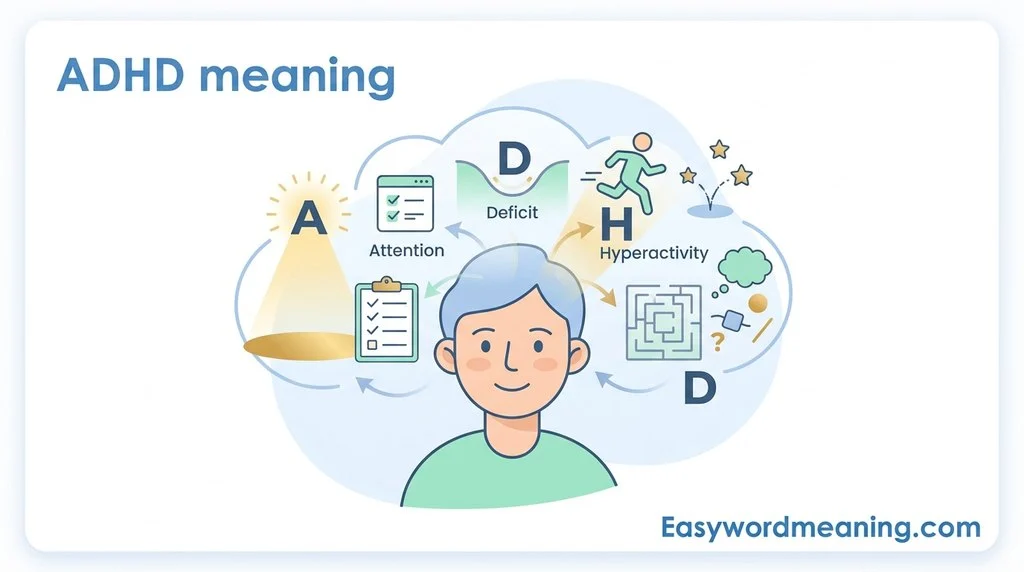
If you have seen ADHD in a text message, social media post, video, article, or everyday conversation, you may wonder what it actually means. ADHD stands for Attention-Deficit/Hyperactivity Disorder, a neurodevelopmental disorder associated with ongoing patterns of inattention and/or hyperactivity-impulsivity that can interfere with everyday functioning.
Unlike many texting abbreviations, ADHD is not simply internet slang. It is a medical term that people may use casually online, but its clinical meaning is much more specific. Understanding that difference can help you interpret conversations accurately and avoid using the term in a way that may be misleading or dismissive.
Important: This article provides general educational information. Seeing ADHD-related behaviors in yourself or someone else does not automatically mean that person has ADHD. Diagnosis requires an appropriate evaluation by a qualified healthcare professional.
What Does ADHD Mean?
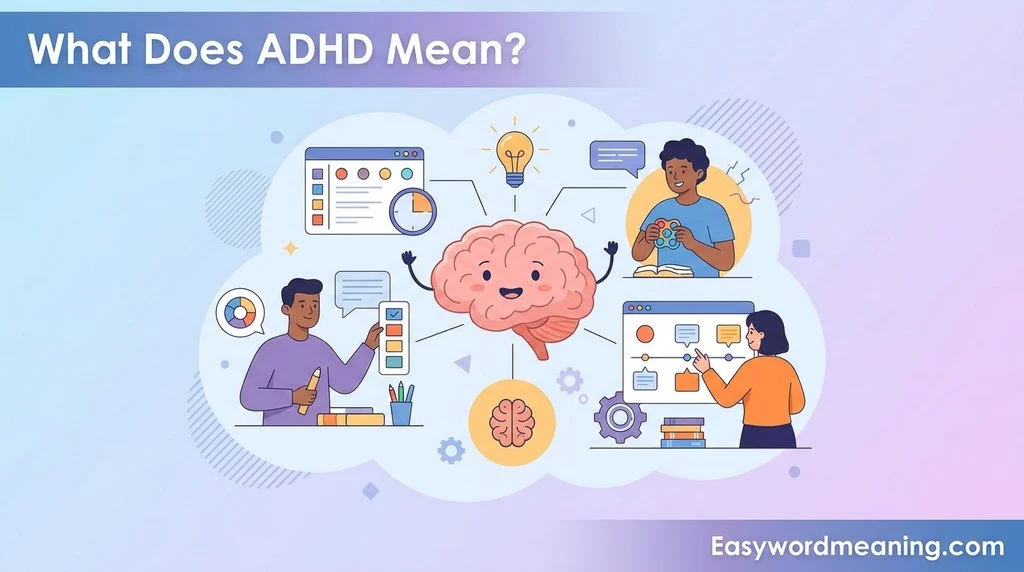
ADHD means Attention-Deficit/Hyperactivity Disorder.
It is a neurodevelopmental disorder involving persistent difficulties with attention and/or hyperactivity and impulsivity. Symptoms can affect areas such as school, work, relationships, organization, and everyday activities.
The three words in the name give a useful starting point:
- Attention-deficit refers to difficulties with attention, organization, following through, or staying focused.
- Hyperactivity can involve excessive activity, restlessness, fidgeting, or difficulty remaining still.
- Impulsivity involves acting or speaking without sufficient consideration, such as interrupting or having difficulty waiting.
Not everyone with ADHD experiences all of these features in the same way. Some people primarily experience inattentive symptoms, while others experience more hyperactive-impulsive symptoms or a combination of both.
What Does ADHD Stand For?
ADHD is short for:
A — Attention
D — Deficit
H — Hyperactivity
D — Disorder
The full term is Attention-Deficit/Hyperactivity Disorder.
You may also see the abbreviation written as ADHD disorder, although technically the final word in the abbreviation already represents “disorder.”
Is ADHD a Texting Abbreviation?
Not in the usual sense.
People sometimes search for “ADHD meaning in text” because they encounter the abbreviation while chatting online. In a conversation, however, ADHD generally keeps its standard meaning: Attention-Deficit/Hyperactivity Disorder.
For example:
“I was diagnosed with ADHD when I was younger.”
Here, ADHD refers to the condition.
Someone might also write:
“My ADHD brain completely forgot that meeting.”
In casual conversation, the speaker may be describing their own experience or using the term informally. However, a person should not assume that someone has ADHD simply because they are distracted, forgetful, restless, or joking about having “ADHD.”
Where Is ADHD Commonly Used?
You can encounter the abbreviation ADHD in many different settings.
1. Text Messages
People may use ADHD when discussing themselves, friends, family members, school, work, or personal experiences.
Example:
“I have ADHD, so I use reminders for important appointments.”
2. Social Media
ADHD is frequently mentioned in posts, comments, videos, memes, and discussions about attention, organization, productivity, or neurodiversity.
Example:
“This productivity system has been really helpful for me with ADHD.”
3. Online Forums
People may discuss diagnosis, treatment, coping strategies, school experiences, workplace challenges, or personal stories.
Example:
“Has anyone with ADHD found a good way to organize long-term projects?”
4. School and Workplace Conversations
The abbreviation can also appear in discussions involving accommodations, concentration difficulties, organization, or educational and professional support.
5. Medical and Health Information
Healthcare websites, clinical resources, and medical professionals use ADHD as the standard abbreviation for Attention-Deficit/Hyperactivity Disorder.
What Are the Main Symptoms of ADHD?
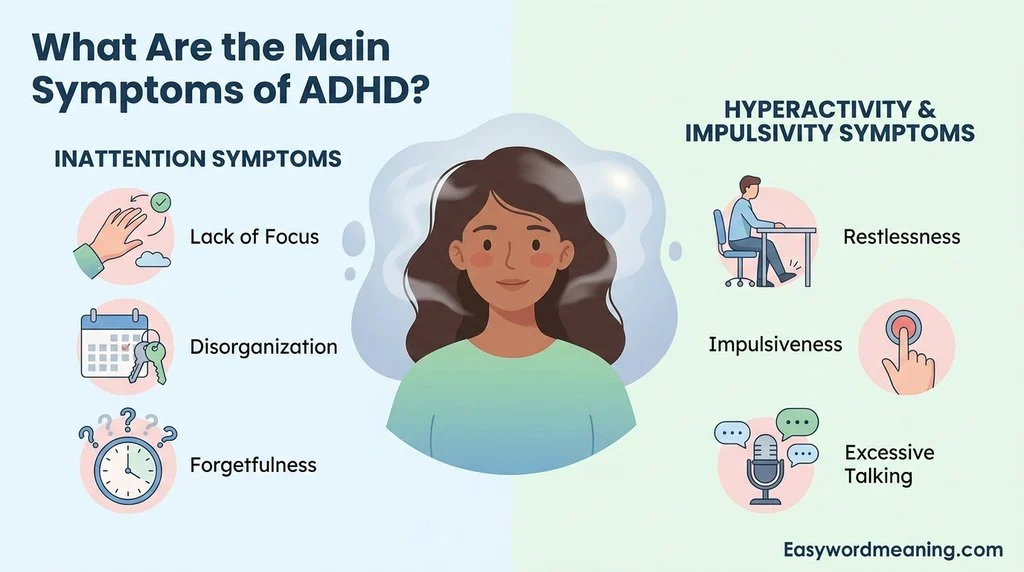
ADHD symptoms are generally grouped into inattention and hyperactivity-impulsivity. A person may have symptoms from one group or both.
Inattention Symptoms
Someone experiencing significant inattentive symptoms may have difficulty with things such as:
- Staying focused on a task
- Following instructions
- Finishing projects
- Keeping things organized
- Managing time
- Remembering appointments or responsibilities
- Avoiding distractions
- Paying close attention to details
- Keeping track of everyday items
- Maintaining attention during conversations
For example, someone might start cleaning their room, notice a book, begin reading it, remember an email they need to send, open their laptop, and suddenly realize an hour has passed.
That kind of experience can happen to anyone occasionally. ADHD is different because symptoms are persistent and can interfere with everyday functioning.
Hyperactivity and Impulsivity Symptoms
These may include:
- Fidgeting or frequent movement
- Feeling restless
- Talking excessively
- Interrupting conversations
- Difficulty waiting for a turn
- Answering before a question is finished
- Acting without thinking through consequences
- Having difficulty sitting still for extended periods
Again, occasional restlessness or impatience does not automatically indicate ADHD.
What Are the Different ADHD Presentations?
Current clinical descriptions recognize three major presentations of ADHD:
- Predominantly inattentive presentation
- Predominantly hyperactive-impulsive presentation
- Combined presentation
The presentation depends on which symptoms are clinically significant at a particular time.
Predominantly Inattentive ADHD
In this presentation, difficulties with attention and organization are more prominent.
A person may frequently:
- Lose track of tasks
- Forget responsibilities
- Become distracted
- Struggle with organization
- Have trouble following instructions
- Make careless mistakes
Predominantly Hyperactive-Impulsive ADHD
Here, hyperactivity and impulsivity are more prominent.
A person may experience:
- Restlessness
- Frequent fidgeting
- Excessive talking
- Difficulty waiting
- Interrupting others
- Acting impulsively
Combined Presentation
A person has clinically significant symptoms from both inattentive and hyperactive-impulsive categories.
It is also important to understand that symptoms can change over time. The way ADHD appears in childhood may not look exactly the same during adolescence or adulthood.
ADHD Meaning in Text: Examples of Conversations
Here are some realistic examples showing how ADHD may appear in modern online communication.
Example 1: Talking About a Diagnosis
Person A: “Why do you always use so many reminders?”
Person B: “I have ADHD, and reminders help me stay organized.”
In this example, ADHD refers directly to the person’s diagnosis.
Example 2: Talking About Focus
Person A: “Did you finish the report?”
Person B: “Not yet. I started working on it, got distracted, and went down a completely unrelated research rabbit hole.”
Person A: “Sounds like your ADHD is making the task harder today.”
Here, the conversation refers to attention and task-management difficulties.
Example 3: Social Media
“My ADHD brain said I needed to organize my desk at midnight.”
This is an informal social-media-style statement. It may describe someone’s personal experience, but context matters.
Example 4: Asking for Advice
“Does anyone have ADHD-friendly study tips?”
In this case, the writer is asking for strategies that may make studying easier for someone experiencing ADHD-related difficulties.
Example 5: Adult Life
“I put the keys in a safe place so I wouldn’t lose them. Now I can’t remember where the safe place is.”
This can be a relatable joke about forgetfulness. However, forgetting something occasionally is not enough to establish ADHD.
How to Use ADHD Correctly in Texts
If you’re using ADHD in a text message, the abbreviation usually doesn’t need any special punctuation.
You can simply write:
- “I have ADHD.”
- “She was diagnosed with ADHD.”
- “I’m reading about ADHD.”
- “He has been learning more about ADHD.”
- “Do you know what ADHD means?”
When discussing another person, it is better to avoid making a diagnosis yourself.
For example, instead of saying:
“You’re definitely ADHD because you can’t sit still.”
A more appropriate approach would be:
“You seem to be having trouble sitting still today.”
That distinction matters because many behaviors associated with ADHD can also occur for other reasons.
Common Mistakes and Misunderstandings About ADHD
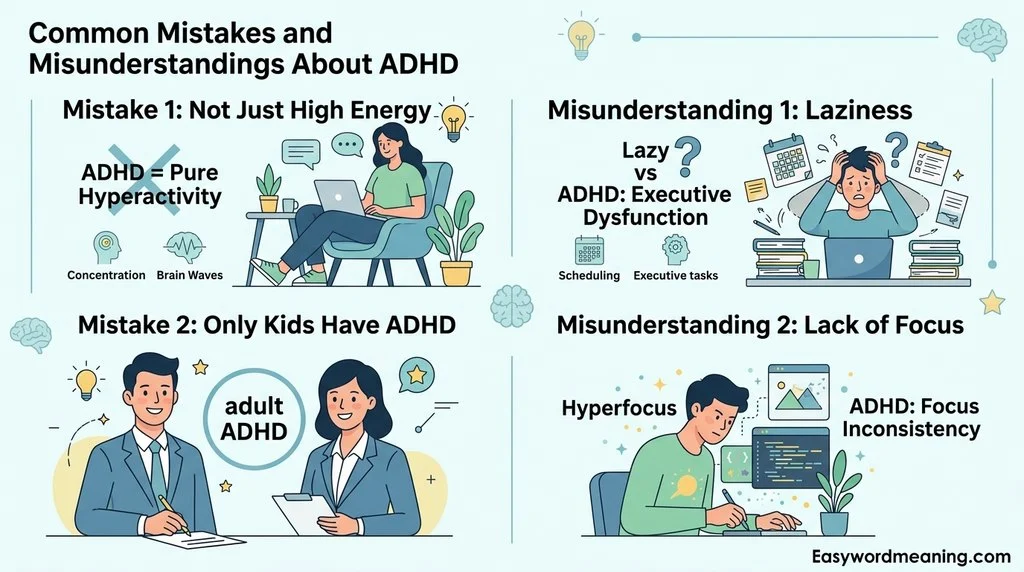
Mistake 1: Thinking ADHD Simply Means Being Distracted
Everyone gets distracted sometimes.
ADHD involves a persistent pattern of symptoms that can interfere with functioning. The Centers for Disease Control and Prevention notes that there is no single test that can independently diagnose ADHD, and other conditions can produce similar symptoms.
Mistake 2: Assuming Everyone With ADHD Is Hyperactive
Not necessarily.
Some people primarily experience inattentive symptoms. Others have hyperactive-impulsive symptoms, while some experience both.
Mistake 3: Thinking ADHD Only Affects Children
ADHD can continue into adolescence and adulthood. Adults can experience difficulties involving attention, organization, restlessness, impulsivity, time management, and completing tasks.
Mistake 4: Using ADHD as a Casual Synonym for Laziness
ADHD should not be treated as another word for laziness, carelessness, or lack of intelligence.
A person may have genuine difficulties with attention, organization, or executive functioning while still being motivated to accomplish their goals.
Mistake 5: Diagnosing Someone From a Text Message
A few messages cannot establish whether someone has ADHD.
Symptoms need to be evaluated in context, including their duration, developmental history, impact on daily functioning, and whether other explanations could account for them.
How Is ADHD Diagnosed?
There is no single test that can diagnose ADHD. Evaluation generally involves several pieces of information and a qualified healthcare professional’s assessment.
According to NIMH, diagnostic evaluation can involve:
- Reviewing current symptoms.
- Considering childhood history.
- Looking at behavior in different settings.
- Reviewing medical and mental health history.
- Using standardized symptom questionnaires or rating scales.
- Considering other conditions that could produce similar symptoms.
For a diagnosis, symptoms must meet established clinical requirements. NIMH notes that symptoms need to have begun during childhood, occur in more than one setting, persist for at least six months, and interfere with social, school, or work functioning.
This is why an online quiz or a social-media checklist should not be treated as a diagnosis.
ADHD in Children vs. Adults
ADHD in Children
Children may show behaviors such as:
- Frequent fidgeting
- Difficulty remaining seated
- Forgetfulness
- Daydreaming
- Excessive talking
- Difficulty taking turns
- Trouble following instructions
These behaviors become clinically important when they are persistent, significant, and interfere with everyday functioning.
ADHD in Adults
Adults may experience:
- Difficulty organizing responsibilities
- Procrastination
- Forgetfulness
- Trouble managing time
- Difficulty completing large projects
- Restlessness
- Interrupting others
- Difficulty maintaining attention
- Losing everyday objects
The symptoms can affect work, relationships, education, and daily routines.
What Causes ADHD?
There is not one simple cause of ADHD.
Researchers continue to study the biological and environmental factors involved. NIMH reports that research suggests genetics plays an important role, while researchers are also examining differences in brain development and other potential contributing factors.
It is therefore inaccurate to reduce ADHD to a single explanation such as “too much screen time” or “bad parenting.”
Can ADHD Be Treated?
Yes. Treatments and support strategies can help people manage ADHD symptoms and improve daily functioning.
Depending on the individual and their circumstances, treatment may include:
- Medication
- Psychotherapy
- Behavioral interventions
- Parent education for children
- School-based support
- Other individualized strategies
NIMH notes that effective treatments are available and that treatment plans can vary according to age, symptoms, and individual needs.
Anyone concerned about possible ADHD should discuss their symptoms with an appropriate healthcare professional rather than trying to self-diagnose from social-media content.
Related Terms and Abbreviations
If you’re researching ADHD meaning, you may also encounter these related terms:
ADD
ADD stands for Attention Deficit Disorder.
You may still see people use “ADD” in casual conversation, but current clinical terminology generally uses ADHD rather than ADD. Modern descriptions recognize different ADHD presentations, including predominantly inattentive presentation.
Neurodevelopmental Disorder
A neurodevelopmental disorder is a condition related to development of the nervous system that can affect functioning. ADHD is classified as a neurodevelopmental disorder.
Inattention
Inattention refers to difficulties such as maintaining focus, organizing tasks, following through, or remembering details.
Hyperactivity
Hyperactivity can involve excessive movement, activity, or restlessness.
Impulsivity
Impulsivity refers to acting or responding without sufficiently considering the consequences, such as interrupting or having difficulty waiting.
FAQs:
What does ADHD stand for?
ADHD stands for Attention-Deficit/Hyperactivity Disorder. It is a neurodevelopmental disorder involving persistent patterns of inattention and/or hyperactivity-impulsivity that can interfere with everyday functioning.
What does ADHD mean in texting?
In texting, ADHD normally has the same meaning as it does elsewhere: Attention-Deficit/Hyperactivity Disorder. People may use it when discussing their diagnosis, symptoms, experiences, or information about the condition.
Is ADHD considered slang?
No. ADHD is primarily a medical abbreviation, not ordinary internet slang. People may use it casually in social-media conversations, but the underlying term refers to a recognized neurodevelopmental disorder.
Can adults have ADHD?
Yes. ADHD can continue from childhood into adolescence and adulthood. Adults may experience symptoms differently from children, with issues such as organization, time management, attention, restlessness, and impulsivity becoming especially noticeable.
Does being forgetful mean you have ADHD?
No. Forgetfulness happens to everyone. ADHD involves a broader and persistent pattern of symptoms that can significantly interfere with everyday functioning. Other conditions, including sleep problems, anxiety, depression, and some learning difficulties, can also cause similar problems.
Final Thoughts :
So, what does ADHD meaning actually refer to? ADHD stands for Attention-Deficit/Hyperactivity Disorder, a neurodevelopmental disorder associated with persistent patterns of inattention and/or hyperactivity-impulsivity. It can affect children, teenagers, and adults, and it can look different from one person to another.
If you encountered ADHD in a text, comment, or social-media post, the surrounding conversation can help explain exactly how the person is using the term. Just remember that casually noticing a few ADHD-like behaviors is not the same as receiving a diagnosis.
For accurate health information, rely on qualified healthcare professionals and reputable medical sources rather than social-media assumptions. Share your favorite text abbreviation in the comments!

Hi, I’m Musaghumman, the mind behind EasyWordMeaning. I turn confusing words into easy meanings so anyone can learn, understand, and use English with confidence.